Rabbi James A. Wax, 1912-1989, remains a respected and accomplished figure in the world of Jewish leadership and Civil Rights. With a deep commitment to the teachings of the Torah, Rabbi Wax dedicated his entire career to the struggle for Civil Rights and serving as a voice for the voiceless. Rabbi Wax’s unwavering dedication to his faith and its historical values for human rights continues to make a profound impact on his city, his state and our nation.
Righteous Among Men:
Rabbi James A. Wax
A Life Dedicated to Social Justice
The Righteous Life of Rabbi Wax

Early Life

Education

Early Career

Temple Israel

Contributions to the Civil Rights Movement

Rabbi Wax’s
Lasting Impact
Early Life
“Even as a youngster, I was hoping to reform the world, be for the little guy, although I didn’t quite understand the terminology. I saw injustices there (Herculaneum). I saw a good deal of economic and social oppression. This motivated me to try to alleviate injustice and improve the quality of life for all people.”
— Rabbi James A. Wax
Photo by Alan Karchmer
Early Life
James Wax grew up in Herculaneum, Missouri and was known for his early activism and dedication to social justice.
James Wax’s passion for social justice was ignited by the economic and social injustices he witnessed in his hometown, inspiring him to strive for a better world and improve the lives of others through activism and advocacy.
James Aaron Wax was born to the only Jewish family in the small Mississippi River town of Herculaneum, Missouri, on December 20, 1912. His parents, Rose and Morris Wax, immigrated to the U.S. from a small village inside Russia’s Pale of Settlement only two years before, and settled in Herculaneum where a mining company’s smokestack dominated life. Morris Wax taught his son these tenets of Judaism: Be a moral and honorable person and be a good citizen.
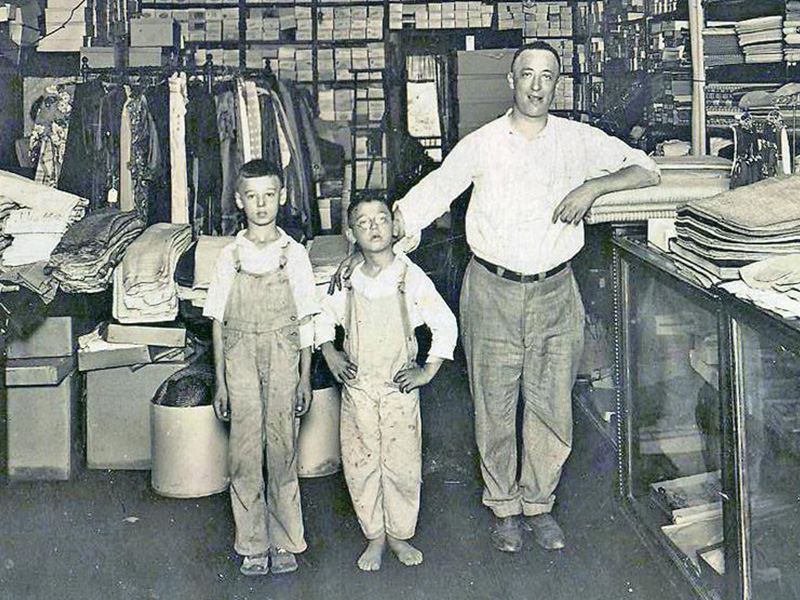
James Wax, left, with brother and father. Photo courtesy of Herculaneum Historical Society
James Wax, his brother, Leon, and their dog, Paducah, were familiar sights in Herculaneum. They worked in the family dry goods store, watched the mail arrive at the post office next door and visited with neighbors as they collected their mail. By the time he was 15, James had his own bank account, although he once said, “making money never appealed to me.” He was known for exceptional academic and leadership skills, winning various oratorical and debating competitions, and never missing a day of school.
As a teenager, James was asked to speak to local groups and in Christian churches, including speaking as a teenager as the keynote speaker at the groundbreaking of an African American church. His topics centered on patriotism, brotherhood, values, and citizenship. He delivered his high school commencement address in 1930. His topic: “Missouri’s Ability to Finance Education.”
What young James Wax saw around him heightened his awareness of social justice. “Even as a youngster, I was hoping to reform the world, be for the little guy, although I didn’t quite understand the terminology. I saw injustices there (Herculaneum). I saw a good deal of economic and social oppression. This motivated me to try to alleviate injustice and improve the quality of life for all people.”
Education
“The Jew has a duty to save civilized values and to hold on to the moral standards now trampled upon. He is fighting for man and for God.”
— Rabbi James A. Wax
Education
Rabbi Wax’s education blended rigorous scholarship with a deep commitment to social ethics. Photo: HUC Cincinnati circa 1935
Rabbi Wax’s education, marked by perseverance and a drive for social justice, led from a Bachelor’s degree to his rabbinical ordination, intertwining Jewish tradition with universal human dignity.
James’ ambition was to study law and become governor of Missouri, but a sermon by Rabbi Ferdinand Isserman changed his plans. As a student at Washington University, he attended services at Temple Israel in St. Louis where he first heard Rabbi Isserman preach, challenging the Temple youth to fight against injustice. Young James said to himself, “If this is Judaism, this is for me.”
Growing up, James never went to religious school. He never had a Jewish friend. He was not a Bar Mitzvah. The Great Depression forced his transfer to Missouri State Teachers College in Cape Girardeau, graduating in 1934. Encouraged by a Methodist minister in Herculaneum to become a rabbi, James applied to the Hebrew Union College (HUC) in Cincinnati.

Illustration of Hebrew Union College, 1875 HUC
His application was rejected. He did not know Hebrew. James then studied Hebrew six days a week and was accepted as a student. Later, when interviewed for admission to the HUC, faculty member Dr. Jacob Rader Marcus asked: “Mr. Wax, how do you think you will like living at college?” His reply: “I’ve never lived among Jews before, but I’m willing to give it a try.”
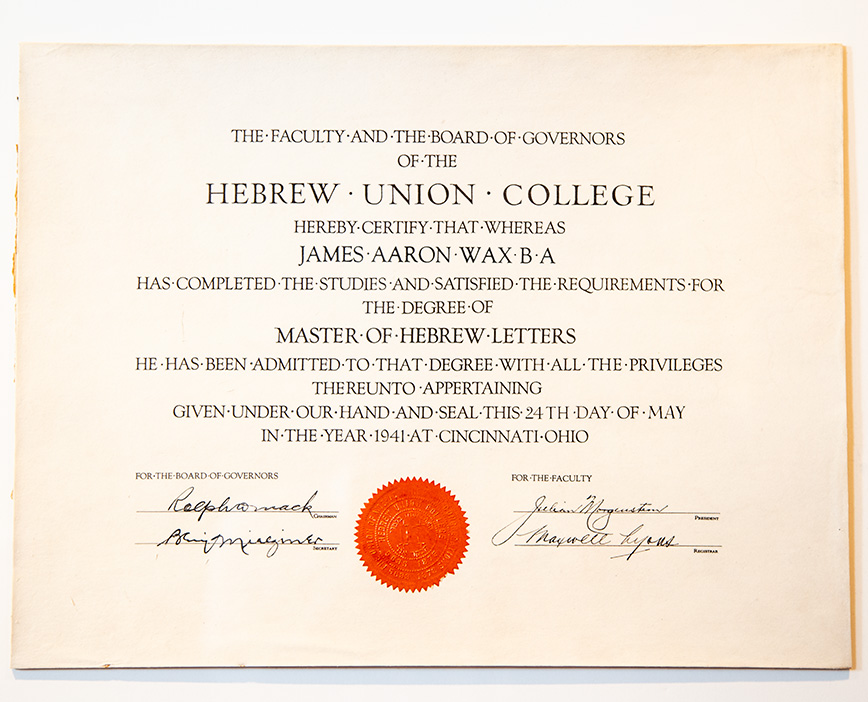
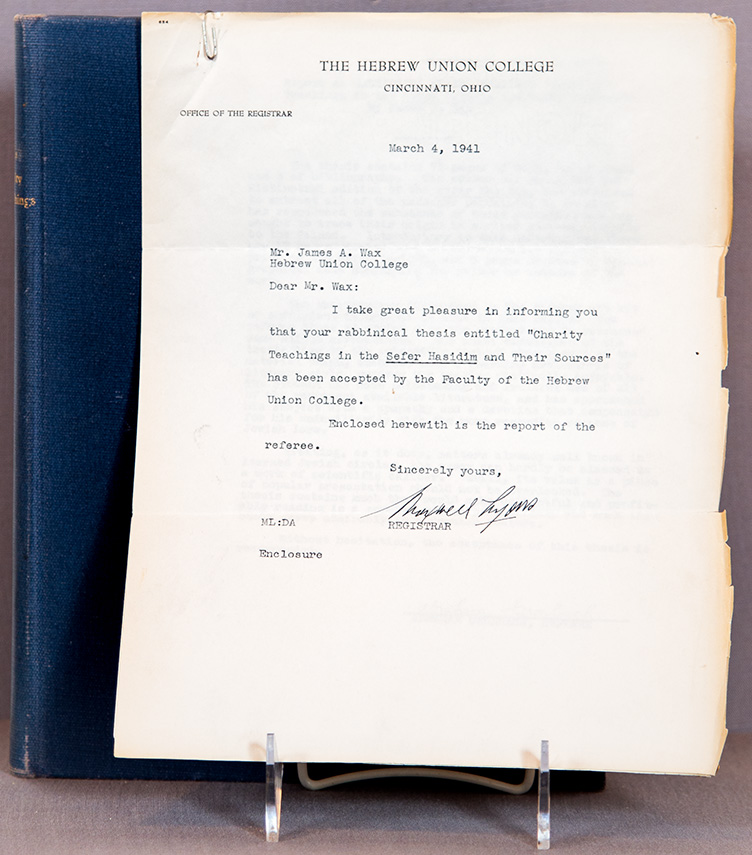
He was admitted to the HUC in 1935. There he met Richard C. Hertz of St. Paul, Minnesota, who became a life-long friend. James flourished in the academic environment. While a student at HUC, he perfected the distinctive delivery of his sermons from the pulpits of synagogues in Texas, Mississippi, Ohio, and Illinois. When James graduated from HUC in 1939, he had earned the highest grades in Hebrew in his class. In 1941, he received a master’s degree in Hebrew Letters and was ordained as Rabbi.
His friend, now Rabbi Hertz and assistant rabbi at North Shore Congregation Israel in Glencoe, Illinois, joined the military’s Chaplaincy Corps in 1943 during World War II. He asked Rabbi Wax to fill in for him until the war ended. It was there that Rabbi Wax met Helen Louise Goldstrom.
Rabbi Wax and Helen Goldstrom married February 25, 1945, in her Baltimore home. One year later, Rabbi Wax learned of an assistant rabbi opening at Temple Israel in Memphis.

Wax is a student at Washington University, St. Louis
August 8, 1931
1930-1932
1935
Wax receives Bachelor of Arts from Southeast Missouri State Teachers College, Cape Girardeau, Missouri

Wax is admitted to Hebrew Union College
October 17, 1935
At The Hebrew Union College Wax met Richard C. Hertz of St. Paul, Minnesota, who became a life-long friend. Hertz recalled:
“We studied together, we worked together, we shared one suit that we bought for $5; whoever had a date wore the suit. We shared our heroes, Dr. Jacob Marcus and Mrs. Lillian Waldman, and we shared a lot of Old Grand-Dad.”
1935
1939
Awarded Bachelor of Hebrew Letters, Hebrew Union College, Cincinnati
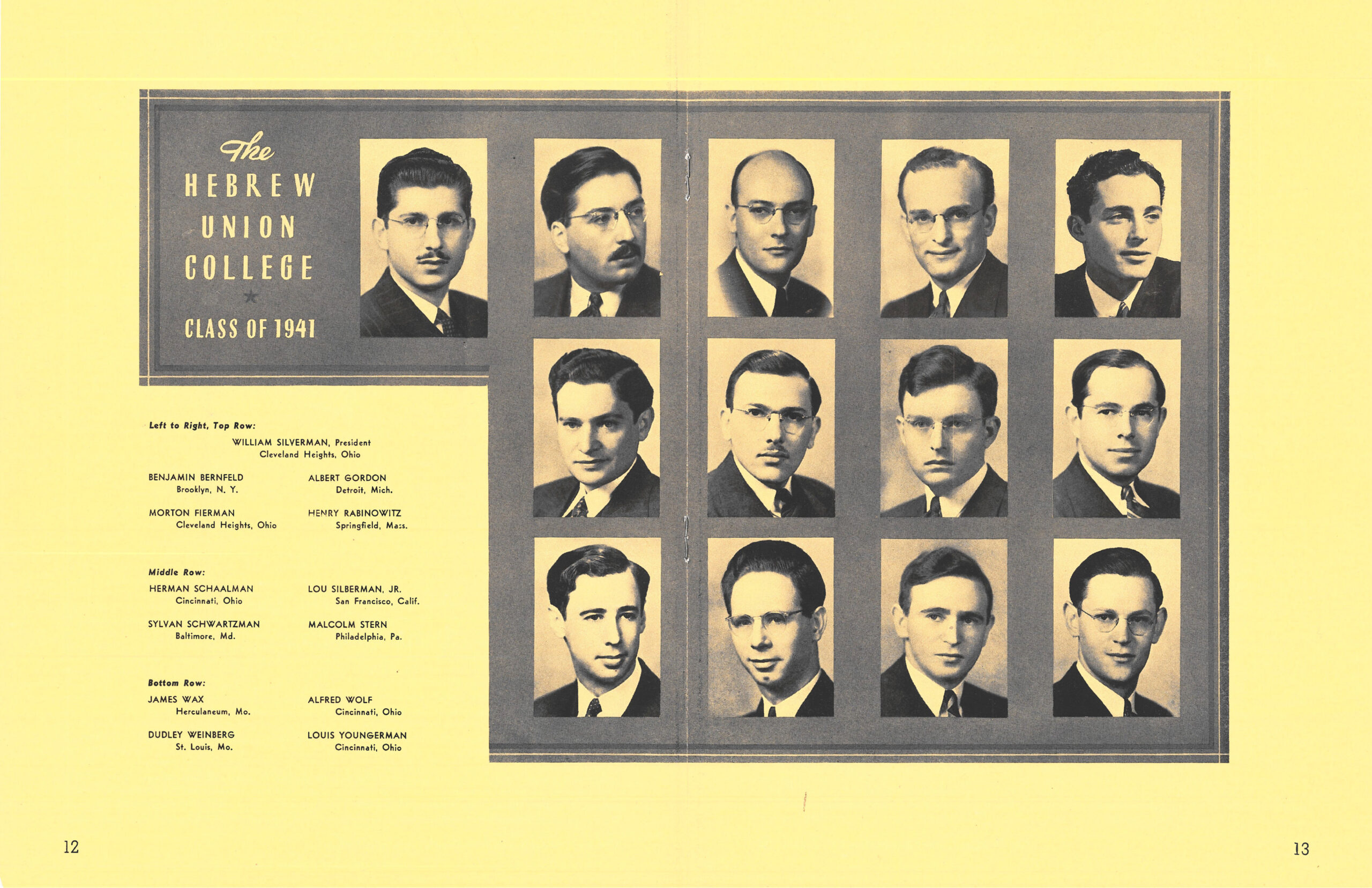
Awarded Master of Hebrew Letters, Hebrew Union College, Cincinnati
1941


Early Career
“The American Dream, as noble as it is, has not been fully attained nor realized. Many in our nation are ill-fed, ill-housed, ill-clad. The prerogative of citizenship is still denied to many. If America is to be truly free as the leader of nations, it must redeem itself from injustices that detract from the happiness of countless Americans.”
— Rabbi James A. Wax
Early Career
Explore Rabbi Wax’s early career as he champions social justice and ethical leadership, including his pivotal Senate testimony. Photo: United Hebrew Union Congregation, courtesy Jewish Museum of the American West.
In his early career, Rabbi James Wax evolved from an assistant rabbi in St. Louis to a nationally recognized figure, advocating for social justice and ethical issues, and laying the foundation for his future leadership in religious and social activism.
Rabbi James Wax’s early career, beginning with his role as an assistant rabbi at the United Hebrew Congregation in St. Louis in 1941, was a time of significant professional and personal growth. During this formative period, he not only refined his abilities in religious leadership and community engagement but also started to voice his stance on various national and ethical issues. His tenure at the United Hebrew Congregation was not merely about fulfilling his religious duties; it was a platform for him to integrate his passion for social justice and ethical advocacy into his everyday clerical work.

Mezuzah from Rabbi Wax’s home during his tenure as Temple Israel Rabbi

Chanukiah from Rabbi Wax’s home during his tenure as Temple Israel Rabbi
Rabbi Wax’s viewpoints on controversial subjects became increasingly well-known during this time. He was an outspoken opponent of capital punishment, a firm supporter of the United Nations, and a critic of Tennessee’s anti-evolution law. His belief that scientific facts, including the theory of evolution, did not contradict religious truths was both progressive and reflective of his broader worldview. He famously stated, “There is not a single scientific fact, including evolution, that has undermined a single religious truth. God remains the Creator whether the world was formed in six days or six million years.” This approach highlighted his ability to harmonize faith with reason and science, a standpoint that was forward-thinking for its time.
Rabbi Wax’s increasing prominence in the religious and social spheres was evident by his inclusion in Who’s Who in Chicago. In 1945, a significant moment in his early career was captured when he was photographed for Life magazine. This photo was taken while he was testifying on behalf of the Central Conference of American Rabbis before the U.S. Senate Foreign Relations Committee, where he advocated in support of the United Nations. This testimony was not just a personal achievement but also a public declaration of his commitment to global unity and peace, themes that resonated deeply with his theological and ethical beliefs.
In these early years of his career, Rabbi Wax laid the groundwork for what would become a lifelong dedication to merging religious leadership with social and ethical activism. His time in St. Louis and his engagement with national issues set the stage for his later work in Memphis, where he would further amplify his voice in the realm of social justice and human rights.
1941 - 1943
Assistant Rabbi, United Hebrew Congregation, St. Louis, Missouri
In one of his first sermons in 1942 as assistant rabbi at United Hebrew Congregation in St. Louis, Rabbi Wax talked about the social justice message that would resonate throughout his life. Rabbi Wax was only 29 years old.
Rabbi Wax had hoped to join his friend in the Chaplaincy Corps, but the military turned him down.
The Army said he was under weight. Helen Louise Goldstrom was a graduate of Goucher College who worked in Chicago during World War II as acting director of the National Federation of Temple Youth (NFTY). When she needed help with a youth program, she was told by a friend to “call Jimmy Wax.” She did, and he then asked her to accompany him to a dinner honoring his hero and mentor, Dr. Jacob Rader Marcus. Mrs. Wax later recalled: “Shortly after our arrival, Rabbi (Louis) Binstock said,‘Jimmy, why don’t you marry Helen, and I’ll preach for you when you go away on your honeymoon.’ Since we had just met that afternoon, I was startled, to say the least. If he had not been visiting the Binstocks, Jimmy might never have gotten the idea to marry me.” Rabbi Wax was acting rabbi at North Shore Congregation at Hertz’s request until the end of World War II.
1943 - 1945
1945
Assistant Rabbi, United Hebrew Congregation, St. Louis, Missouri
Married Helen Louise Goldstrom - February 25, 1945

Rabbi Wax delivers commencement address at Herculaneum High School
May 18, 1945
Although he was serving as the interim head rabbi in Glencoe, Rabbi Wax was not forgotten in Herculaneum. He returned home in May 1945 to deliver the commencement address at Herculaneum High School to more than a thousand people.
1945
1945
Testifies to U.S. Senate Foreign Affairs Committee in support of United Nations
July 13, 1945
Rabbi Wax’s position on controversial issues was well known. He opposed capital punishment, he supported the United Nations, and he opposed Tennessee’s anti-evolution law: “There is not a single scientific fact, including evolution, that has undermined a single religious truth. God remains the Creator whether the world was formed in six days or six million years.”
Rabbi Wax already was making a name for himself. He was listed in Who’s Who in Chicago, and in 1945 his photo was published the national magazine, Life, testifying on behalf of the Central Conference of American Rabbis before the U.S. Senate Foreign Relations Committee in support of the United Nations.
Associate Rabbi United Hebrew Congregation St. Louis, Missouri
1946
Temple Israel
“No man in this congregation, no man in this community, no man in this state, no man in this nation, yes, no man in the wide universe can dictate to Rabbi Wax what he is to speak about, how he is to interpret the message of God, but as he sees it and as God gives him to see it…”
— Rabbi Ferdinand Isserman
Temple Israel
Rabbi Wax began his transformative 32-year tenure at Temple Israel in Memphis in 1946.
In 1946, Rabbi Wax began a transformative 32-year tenure at Temple Israel in Memphis, where he advanced to senior rabbi, embraced social justice within Reform Judaism, and implemented changes aligning Jewish traditions with contemporary practices.
On April 8, 1946, Rabbi Wax was hired as assistant rabbi at Temple Israel in Memphis, beginning an association that would last 32 years.
It was the perfect position for a rabbi of growing importance. Rabbi Harry W. Ettelson, Temple Israel’s senior rabbi, possessed qualities that Rabbi Wax valued: he was an orator and a scholar; he was interested in public policy; and he was active in building bridges as founder and first president of the forerunner to the National Conference of Christian and Jews. Rabbi Ettelson also emphasized community service over ritual practice, which appealed to his new assistant.
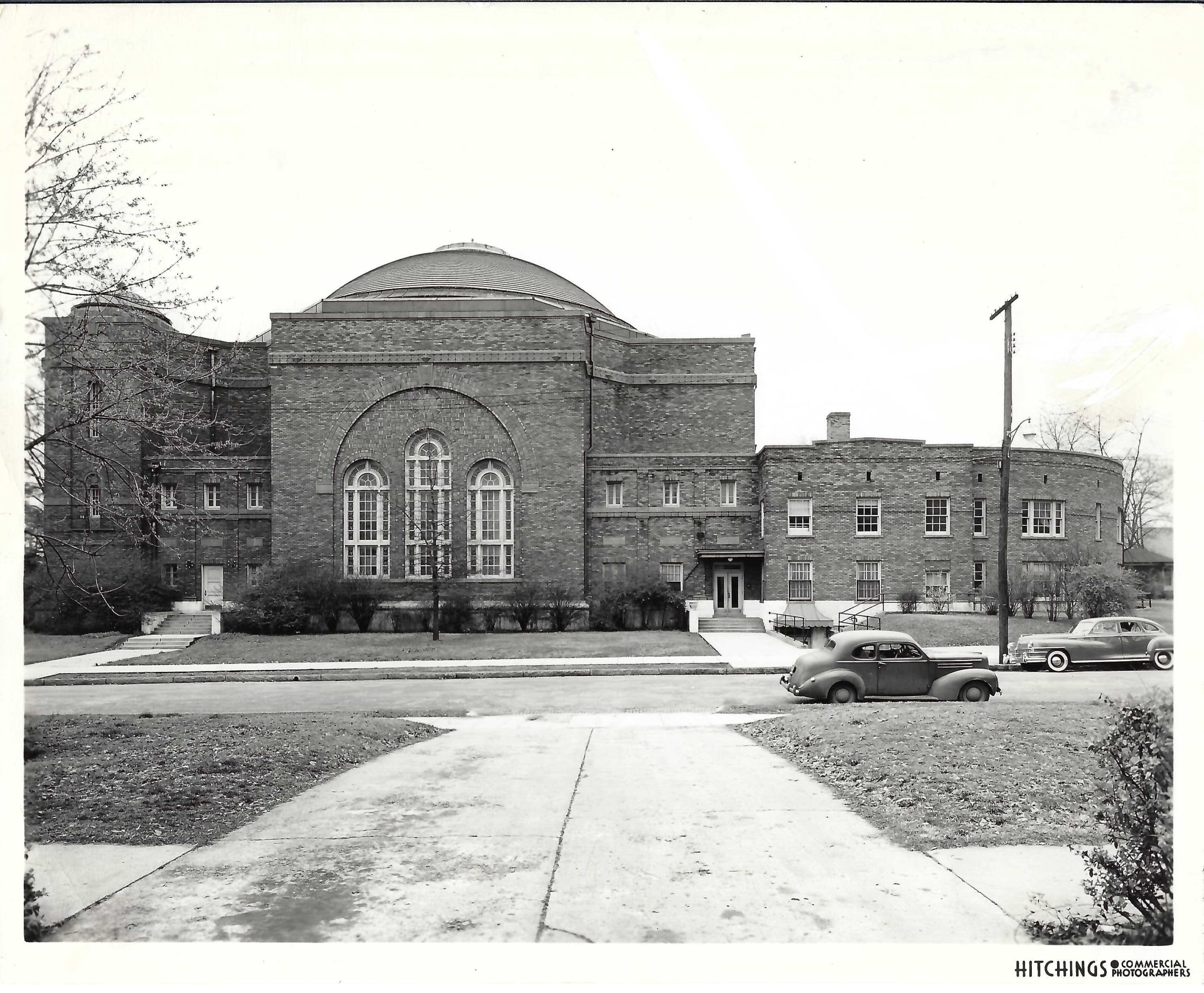
Temple Israel at Poplar and Montgomery. Circa 1948.
Rabbi Wax was promoted to associate rabbi eighteen months later. With Rabbi Ettelson’s encouragement, Rabbi Wax began laying the groundwork for his lifetime commitment to social justice. His reputation in Memphis grew as a force for equal rights. Rabbi Wax became a fixture on numerous Memphis boards and accepted almost every invitation to speak. “I spoke on everything, including integration,” he said. “They’d ask me to speak, and I couldn’t say no.”
On April 2, 1954, Rabbi Wax was installed as the sixth senior rabbi in Temple Israel’s 100-year history. Rabbi Wax associated with Reform Judaism’s social justice movement, which emphasized rights over rites. The Reform Jewish practices at Temple Israel reflected the same, however, he took steps to change some of that. He supported congregants who wanted B’nai Mitzvah ceremonies for their children, and on Rosh Hashanah, he used a ram’s horn as a shofar, rather than a trumpet. He forbade pork and shellfish to be served inside of Temple Israel. Rabbi Wax also added Hebrew classes to the religious school – an act particularly significant because of the absence of Hebrew during his childhood.
1946
Assistant Rabbi, Temple Israel, Memphis
May 31, 1946
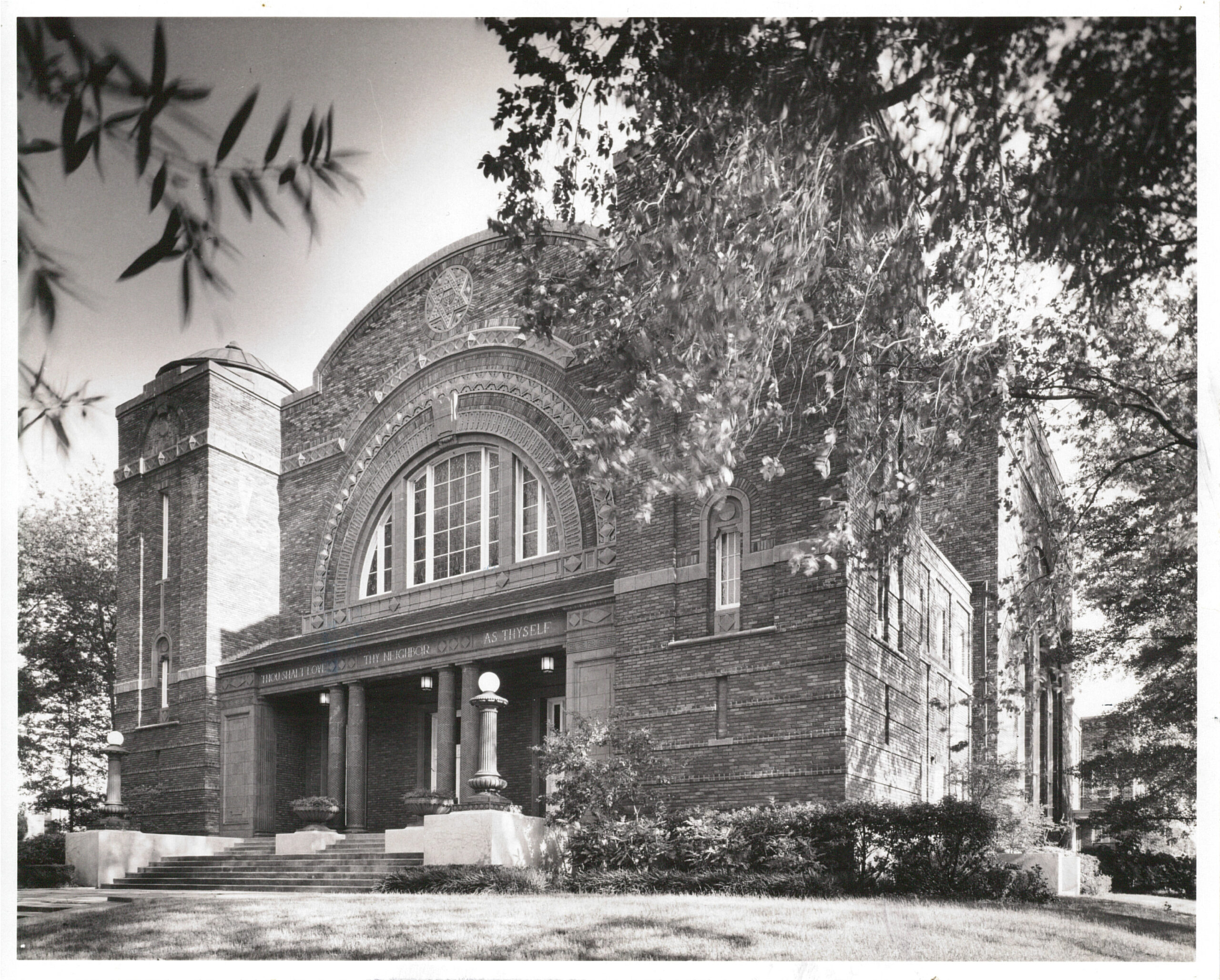
Birth of son, Jonathan Ira Wax
May 23, 1947
1947
1947
Associate Rabbi, Temple Israel
November 3, 1947
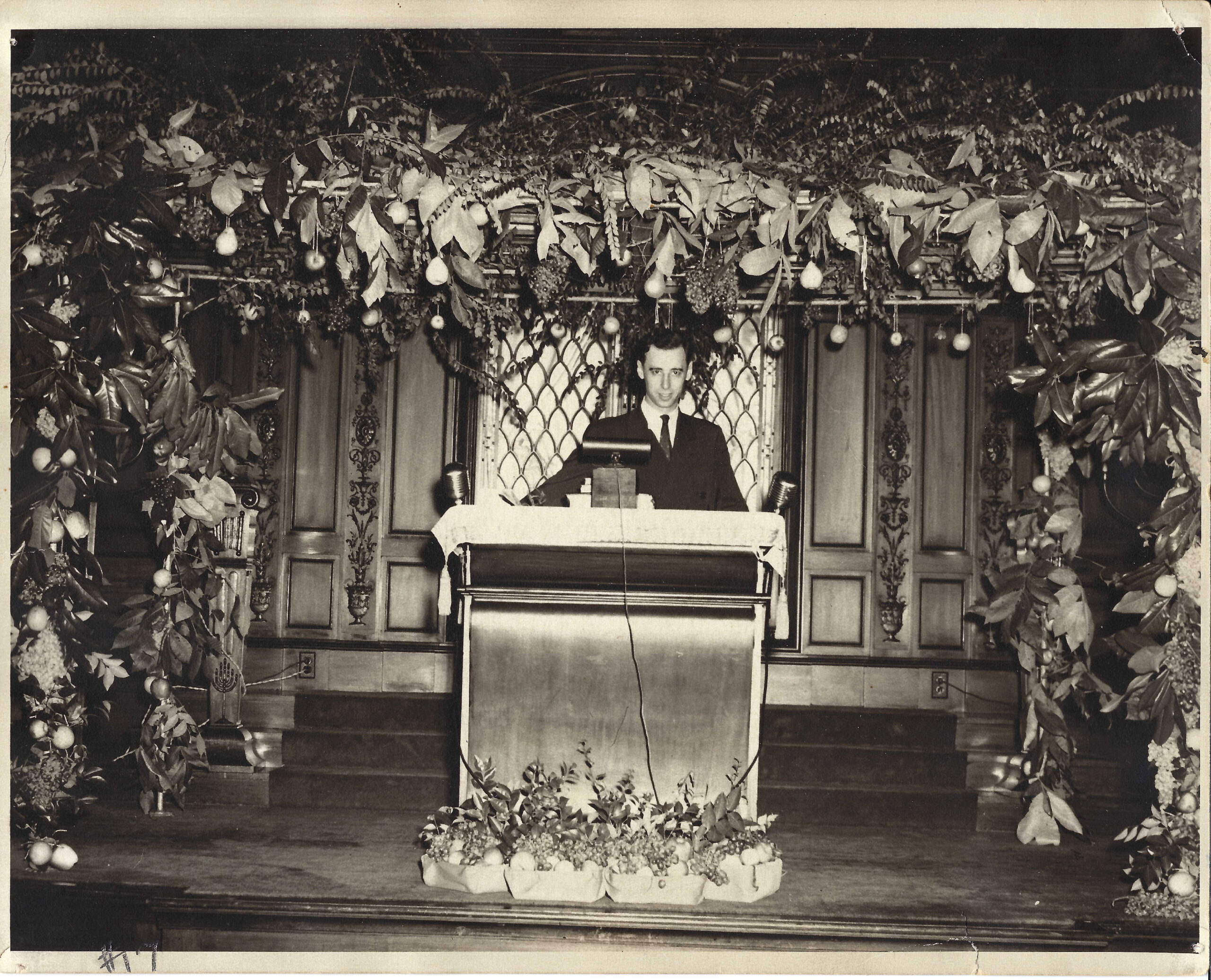
Associate Rabbi James A. Wax officiating during the Holiday of Sukkot at
Temple Israel–Poplar and Montgomery
1948
1950
Elected president of newly-formed Memphis-Shelby County Mental Hygiene Society
Birth of son, James Aaron Wax Jr.
May 17, 1950
1950
1951
Announcement that Rabbi Wax would replace Rabbi Ettelson upon Ettelson’s retirement
November 8, 1951
Tusculum College, Receives Honorary Doctor of Divinity
1952
1953
Rabbi James Wax, Rabbi William Fineshriber, and Dr. Harry Ettelson
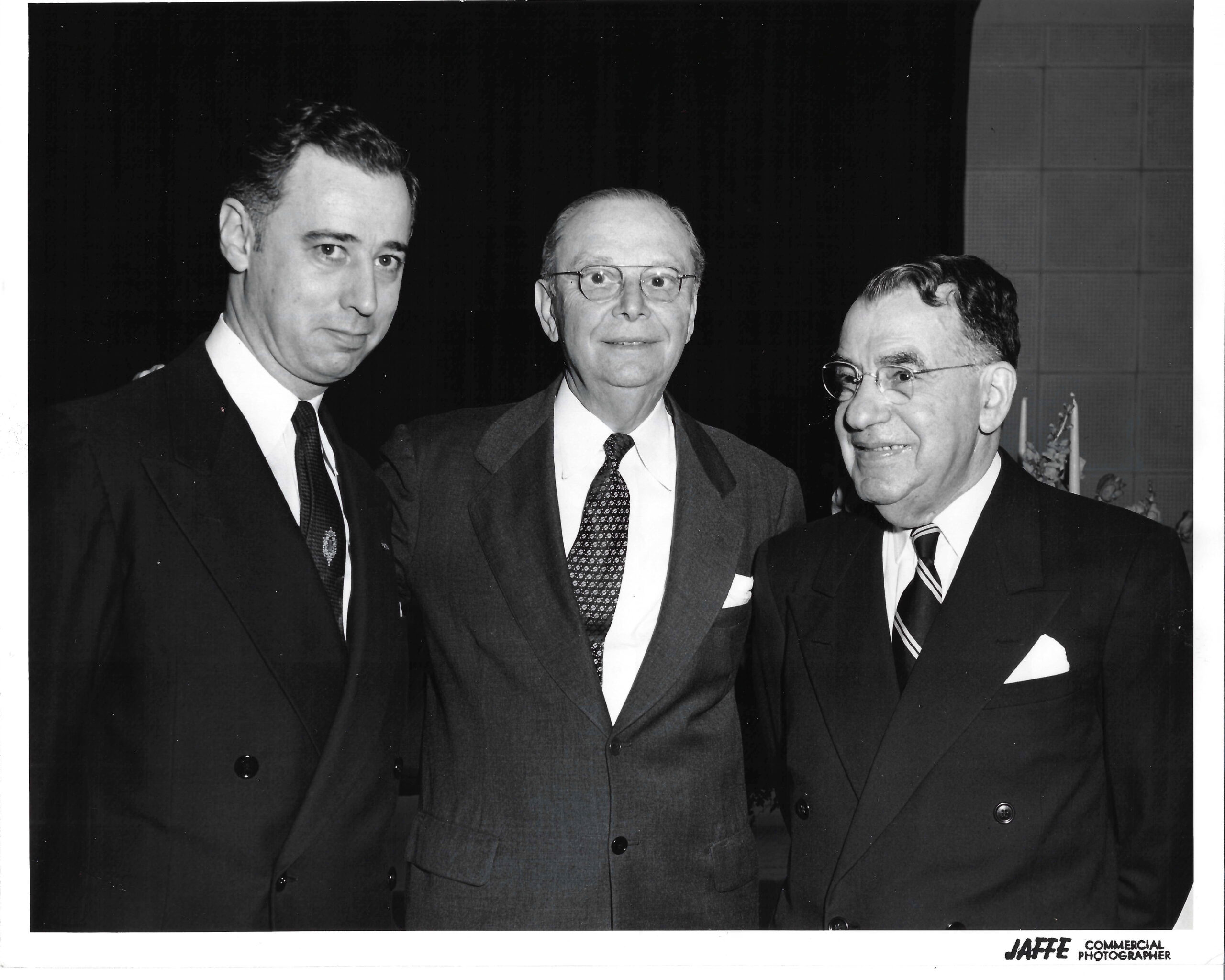
Rabbi Wax becomes a member of the board of directors at Memphis Urban League
1953
1954
Installation as Senior Rabbi, Temple Israel
April 2, 1954
“Dr. Wax is Installed with 1000 Present,” The Commercial Appeal

Installed as the sixth senior rabbi of Temple Israel
April 2, 1954
On April 2, 1954, Rabbi Wax was installed as the sixth senior rabbi in Temple Israel’s 100-year history, then one of the nation’s largest Reform congregations with 1,200 families and more than 600 children in its religious school. At Rabbi Wax’s installation, his mentor, Rabbi Isserman, said: “No man in this congregation, no man in this community, no man in this state, no man in this nation, yes, no man in the wide universe can dictate to Rabbi Wax what he is to speak about, how he is to interpret the message of God, but as he sees it and as God gives him to see it…”
That evening Rabbi Wax staked out an early claim to his social justice message.
1954
1954
Rabbi Ettelson, Nell Ettelson, Rabbi Wax, Helen Wax
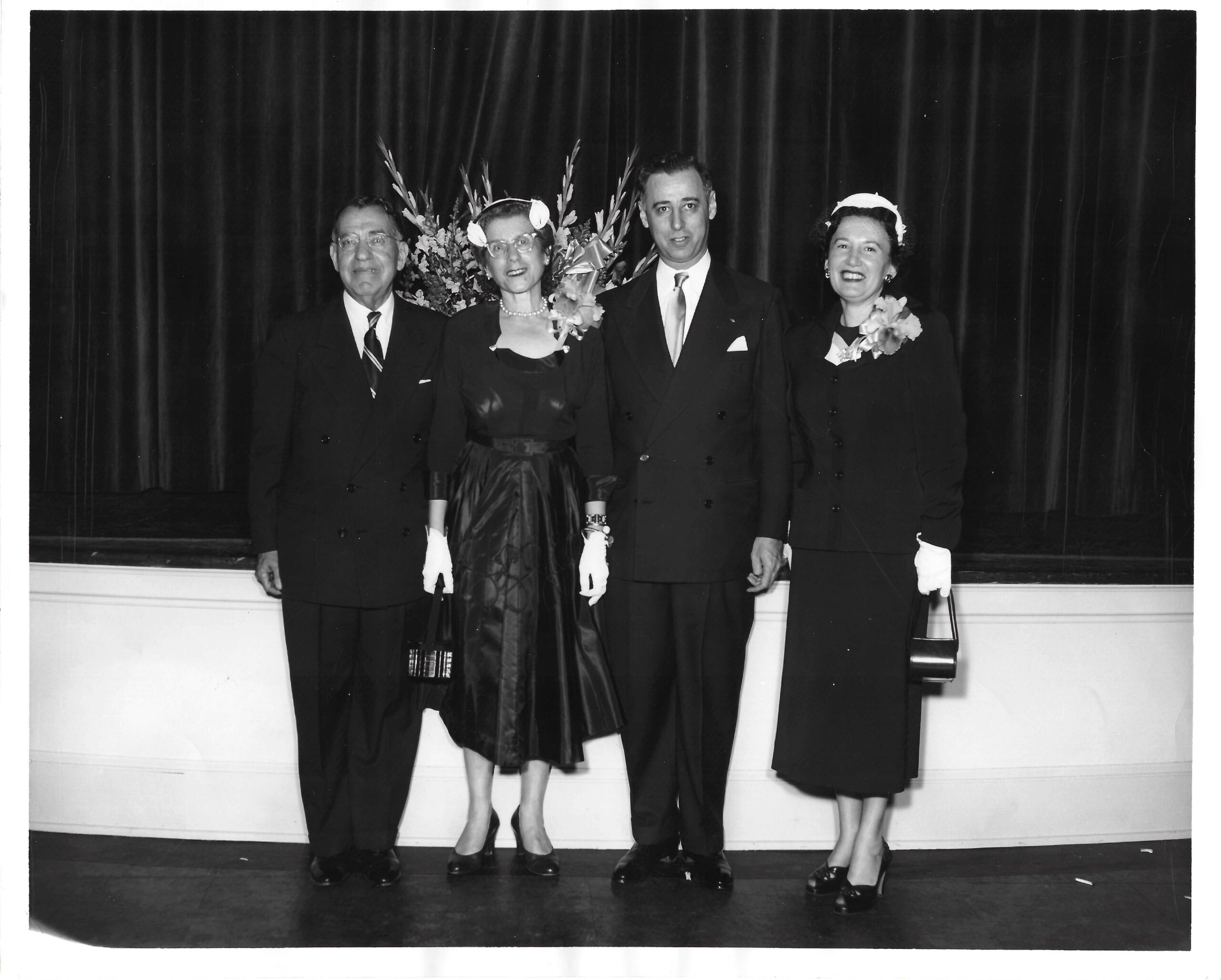
Rabbi James Wax, Helen Wax, and Jonathan Wax at Rabbi Wax’s Installation Dinner as Senior Rabbi of Temple Israel
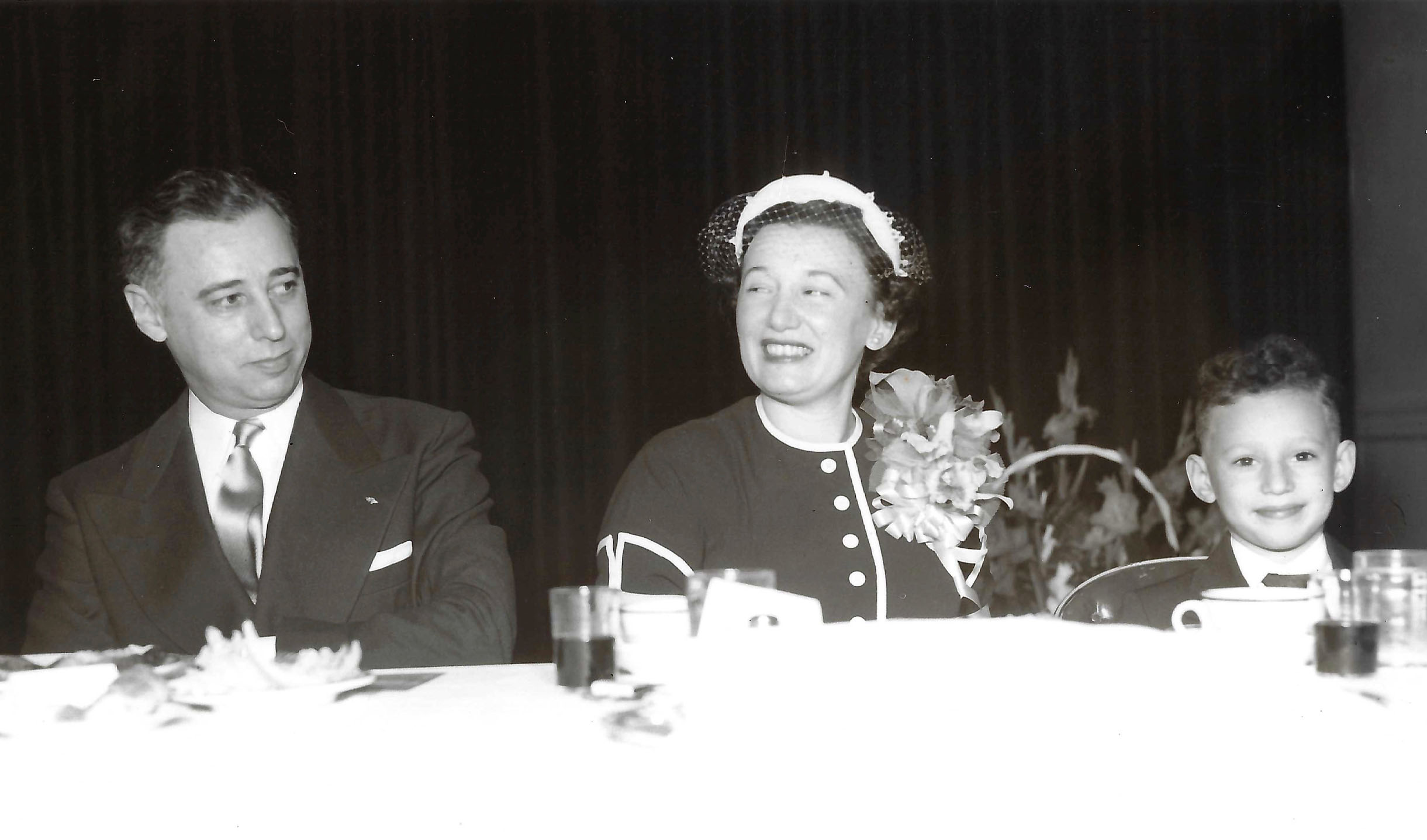
1954
1954
Rabbi Wax named a member of board of trustees for the State of Tennessee Department of Mental Health
Publication of Rabbi and Mrs. Wax’s book about Temple Israel’s first century
1954
1955
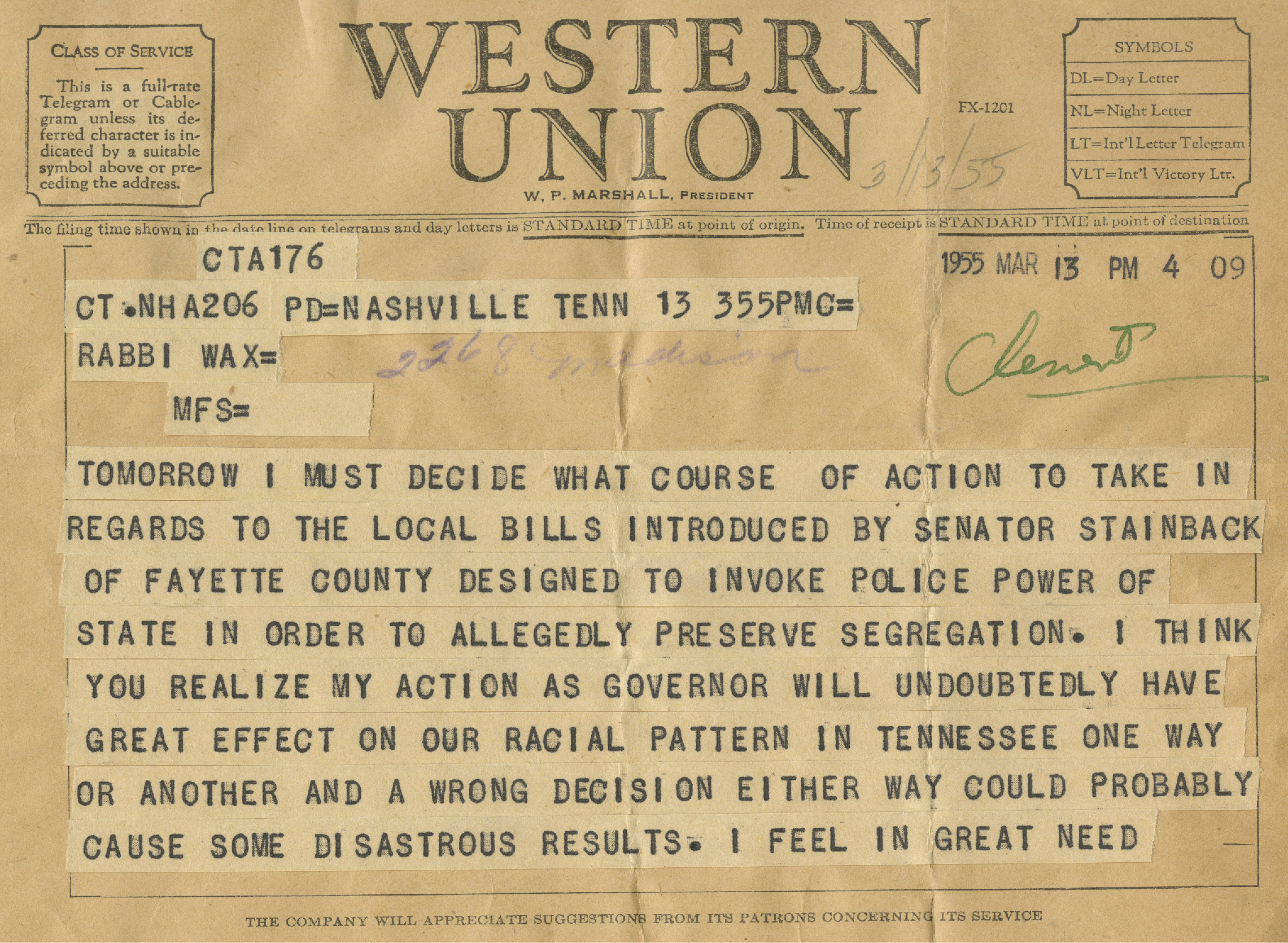
Telegram from Gov. Clement asking for prayer support for his decision re: Fayette Co. segregation
March 13, 1955

Newspaper Guild presents Rabbi Wax with Distinguished Citizenship Award
1956
1956
Rabbi Wax withdraws as speaker at Religious Emphasis Week of Mississippi State College after the cancellation of a white minister opposed to segregation
January, 1956
Tri-State Defender honors Rabbi Wax for promoting racial harmony
March, 1956
1956
1956
Appointed by Tennessee Governor Frank Clement as trustee for first Mental Health Commission
June 30, 1956
Member of Memphis Committee on Community Relations
Rabbi Wax later said that while integration through the committee was successful, it lacked genuine acceptance: “One of the motivating factors for businesspeople was not the moral question, but ‘we’ve got to protect the image of Memphis.’ That phrase ‘image’ was used a number of times. I used to sit back and think, ‘That’s not much of a motivation.’”
1957
1958
Takes part in St. Jude Children’s Research Hospital groundbreaking.
November 2, 1958
Rabbi Wax was among the early supporters to build St. Jude Children’s Research Hospital in Memphis. He also served on the board of the United Cerebral Palsy Association, the Shelby County Tuberculosis Association, and the Mid-South Center Council for Comprehensive Health Planning. St. Jude Children’s Research Hospital opened on February 4th, 1962.

Photo courtesy: Memphis Room, Memphis Public Libraries
Rabbi Wax hosts “Message of Judaism,” a weekly program on WMPS, a popular local radio station.
1961 - 1978
1962
New hospital activities building at Tennessee Psychiatric Hospital and Institute named in honor of Rabbi Wax
May, 1962

Rabbi Wax gives the opening prayer at the dedication of Hebrew Union College in Jerusalem
March, 1963
March 1963 Rabbi Wax gives opening prayer at the dedication of the Hebrew Union College in Jerusalem. David Ben-Gurion, Mrs. Ben-Gurion, Nelson Glueck (President of Hebrew Union College) photographer: David Rubinge
1963
1963
Rabbi James A. Wax and S. L. Kopald outside Temple Israel–Poplar and Montgomery

Temple Israel Archives
Civil Rights Movement
“Social justice, the genuine concern for one’s fellow man, is the cornerstone of Judaism and it must become the cornerstone upon which the world is built. I pledge my life, for whatever it might be worth, to your service. I shall make no distinction by virtue of religion, nationality, or race for we are all children of the one God and shall ultimately share the same fate. May it be God’s will to bless us all by virtue of the goodness of our deeds.”
— Rabbi James A. Wax
Civil Rights Movement
Rabbi Wax’s civil rights leadership underscores his significant role in racial equality efforts.
Rabbi Wax’s civil rights leadership, marked by his presidency of the Memphis Ministers Association and activism after Dr. King’s assassination, underscores his significant role in racial equality efforts.
Rabbi Wax’s censure of Memphis Mayor Henry Loeb the day after the assassination of Dr. Martin Luther King Jr., was called one of the most powerful statements of justice and equality in our time by the Rev. Brooks Ramsey of Second Baptist Church. It was broadcast throughout the nation and reported by nearly every newspaper in America. Rabbi Wax was outraged that the mayor’s intransigence had blocked a solution to the strike of Memphis sanitation workers, which brought Dr. King to Memphis and ultimately to his death.
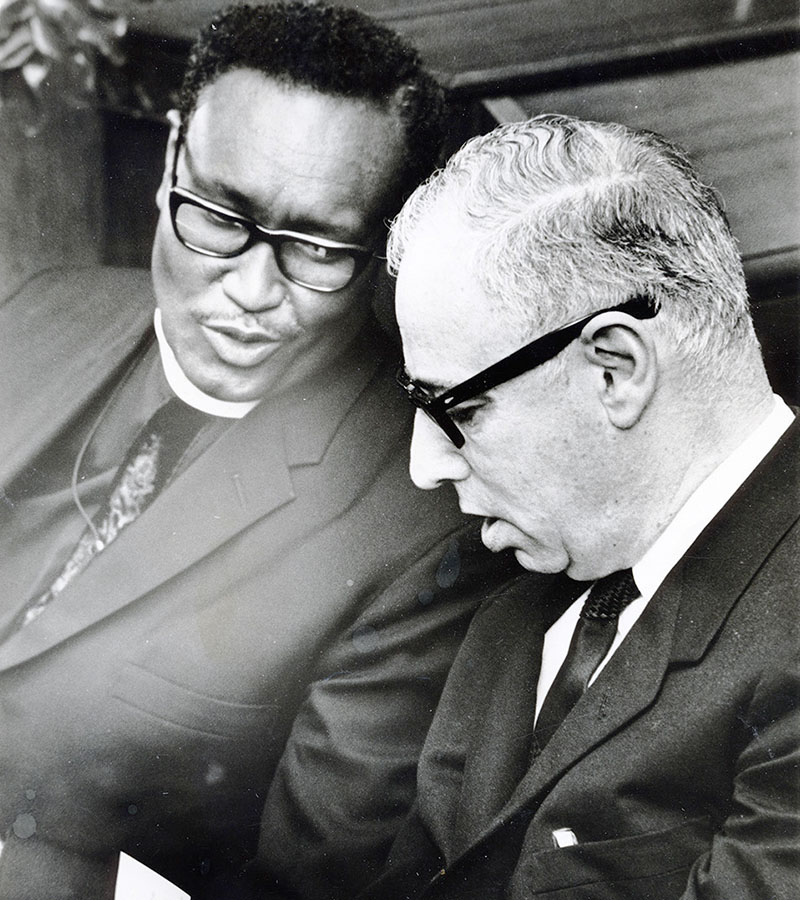
Rev. Starks and Rabbi Wax at Memphis City Hall, April 1968. Sanitation Workers Strike.
Social justice became the thread that bound together the fabric of Rabbi Wax’s life and his rabbinate. Rabbi Wax’s strong stand for equal rights set him apart in a culture far from the norm in the early years of his rabbinate.
In 1952, he joined the board of the Memphis Urban League, a civil rights organization dedicated to economic opportunity, equality, and social justice. By 1956, the Tri-State Defender, the city’s only Black-owned newspaper, recognized him for “his consistent effort to bring about peace and harmony between the races.”
In 1957, Rabbi Wax became deeply involved in the creation of the Memphis Committee on Community Relations, which was charged with successfully and quietly integrating businesses and public facilities. It was a pivotal time in his life. He had been active in the Memphis Ministers Association, the only rabbi of 115 ministers of which only 15 were Black. In October 1967, Rabbi Wax was elected president of the organization, which would result in a historic opportunity to act on his social justice beliefs.
The Memphis sanitation strike began February 12, 1968, an immediate reaction
to the job-related deaths of two sanitation workers. The strike was called to protest deplorable working conditions and to demand higher wages, overtime, dues check-off, and critical safety measures for sanitation workers. On Feb. 16, 1968, Rabbi Wax was asked by Black ministers to convene a meeting with Mayor Loeb to help resolve the strike that had begun just days before. Rabbi Wax told his congregation: “’Let justice well up as waters and righteousness as a mighty stream’ is not a Madison Avenue slogan, but a moral mandate of our faith.”
1965
Rabbi Wax is a founding member of Program of Progress
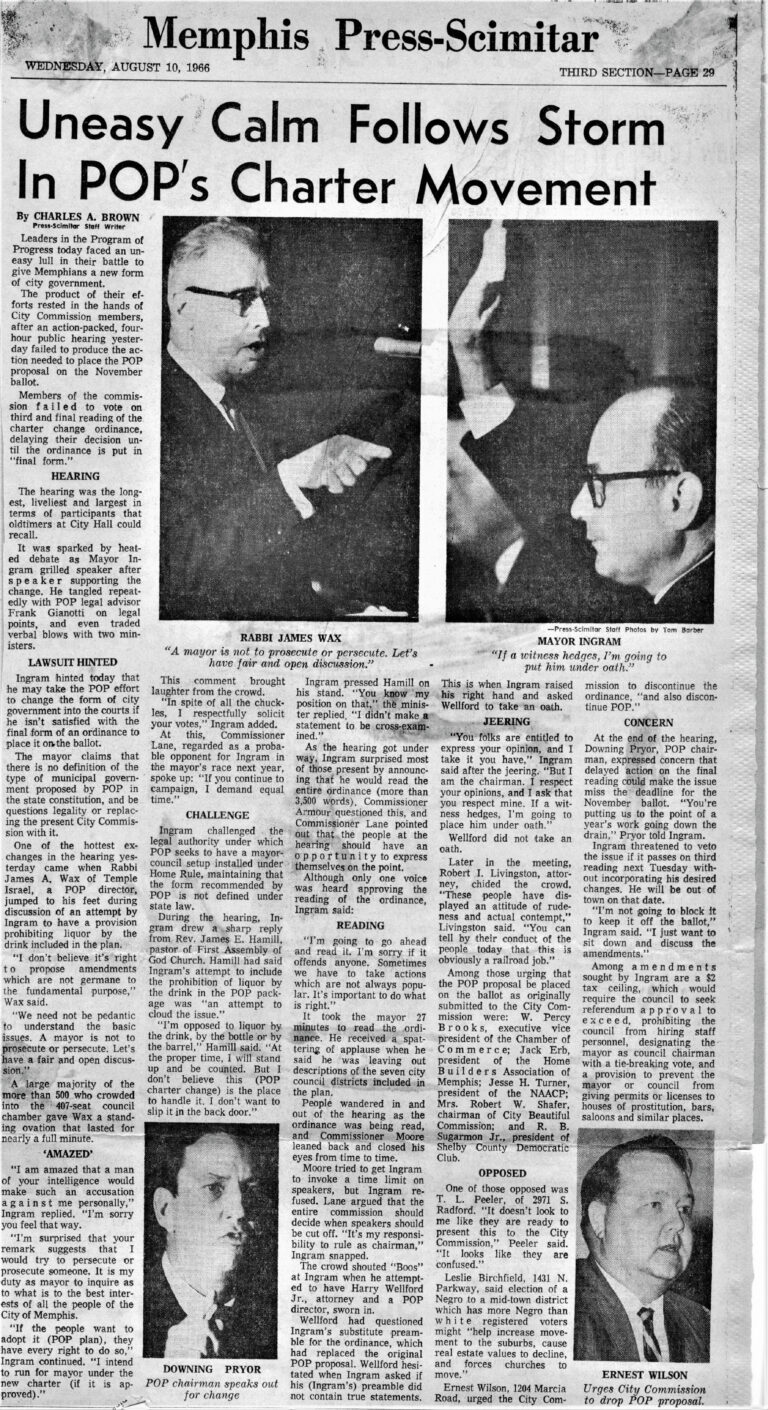
Rabbi Wax was a founding member of the movement to modernize the structure of Memphis city government. As the issue made its way to the ballot box, Memphis Mayor William Ingram tried to slow its momentum, leading to a strong rebuke from Rabbi Wax, who said: “A mayor is not to prosecute or persecute. Let’s have a fair and open discussion.” Memphis voters agreed and approved a new form of city government with a Mayor and City Council.
Rabbi Wax receives an honorary doctorate from Hebrew Union College
June 4, 1966
Rabbi Wax was devoted to Jewish education and religious organizations, serving on the board of governors of the HUC and the Central Conference of American Rabbis. He was president of Southwest Conference of American Rabbis and served on the executive council of the American Jewish Historical Society and the American Jewish Committee.
1966
1966
“Uneasy Calm Follows Storm in POP’s Charter Movement,”
August 10, 1966

Rabbi Wax named president of Memphis Ministerial Association
May 1, 1967
“The ministers association is essentially Christian and yet they chose me,” he said.“It was a greater compliment to the men in the association than it was to me.”
1967
1967
Rabbi Wax speaks out following the Arab-Israeli Six-Day War
June 1967
Rabbi Wax is acclaimed for an inspirational and highly successful plea for the purchase of State of Israel bonds following Arab-Israeli Six-Day War
“Whatever we do that harms another person that dwarfs his being, that denies him the opportunity to achieve his utmost potential is a sin. Prejudice, like robbery, is a sin. Hatred, like adultery, is a sin. No person is either Christian or a good Jew who is guilty of the sin of bigotry and intolerance. Judaism and Christianity, the dominant religions of the Western World, enjoin us to love God and to love our fellow man as our neighbor.”
— Rabbi James A. Wax
Receives Service to Mankind Award presented by Sertoma Club
1967
1968
Rabbi Wax prays at the inauguration of Mayor Henry Loeb of Memphis
January 1, 1968
Prayer transcript for the inauguration of Mayor Henry Loeb and Memphis City Council

Memphis sanitation workers, Echol Cole and Robert Walker, are crushed to death in the rear of a malfunctioning garbage truck.
February 1, 1968
1968
1968
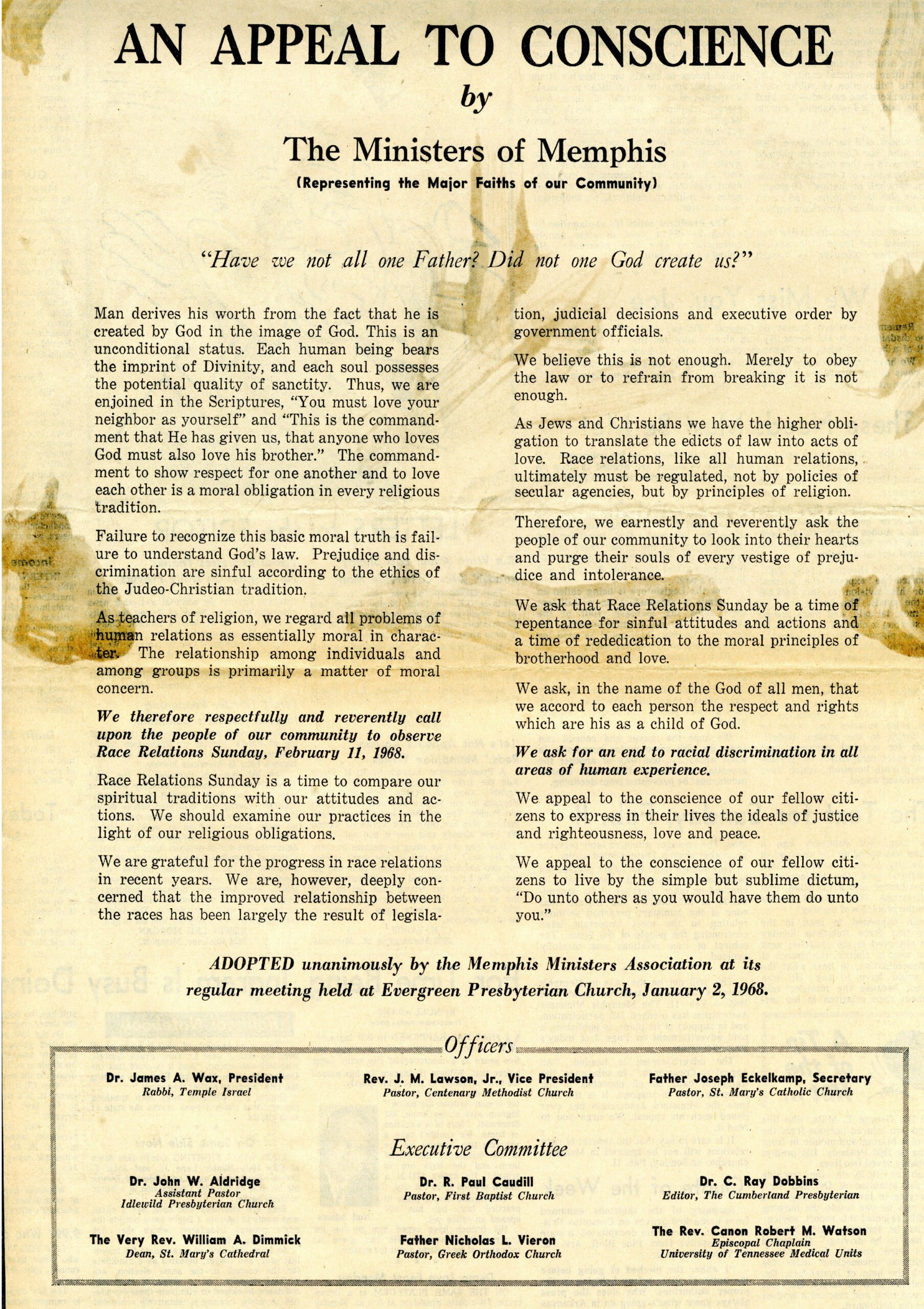
An Appeal to Conscience
February 3, 1968
Rabbi Wax proposed that the Memphis Ministers’ Association issue a statement of principle entitled, “An Appeal to Conscience” calling for an end to racial discrimination “in all areas of human experience,” and called on the public to observe Race Relations Sunday on February 11, 1968. The statement was signed by the association’s executive committee and officers, including Rabbi Wax, and Rev. James Lawson, pastor of Centenary Methodist Church, who was strike chairman and strategist for the sanitation workers’ strike. It was Rev. Lawson’s invitation that brought Dr. Martin Luther King Jr. to Memphis.
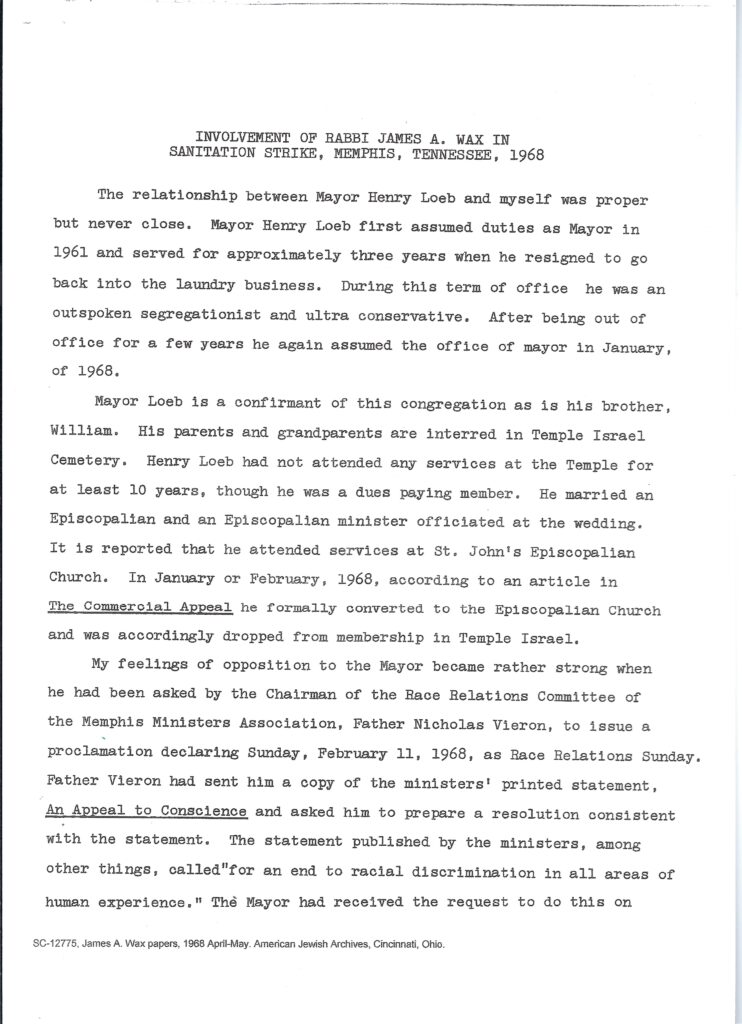
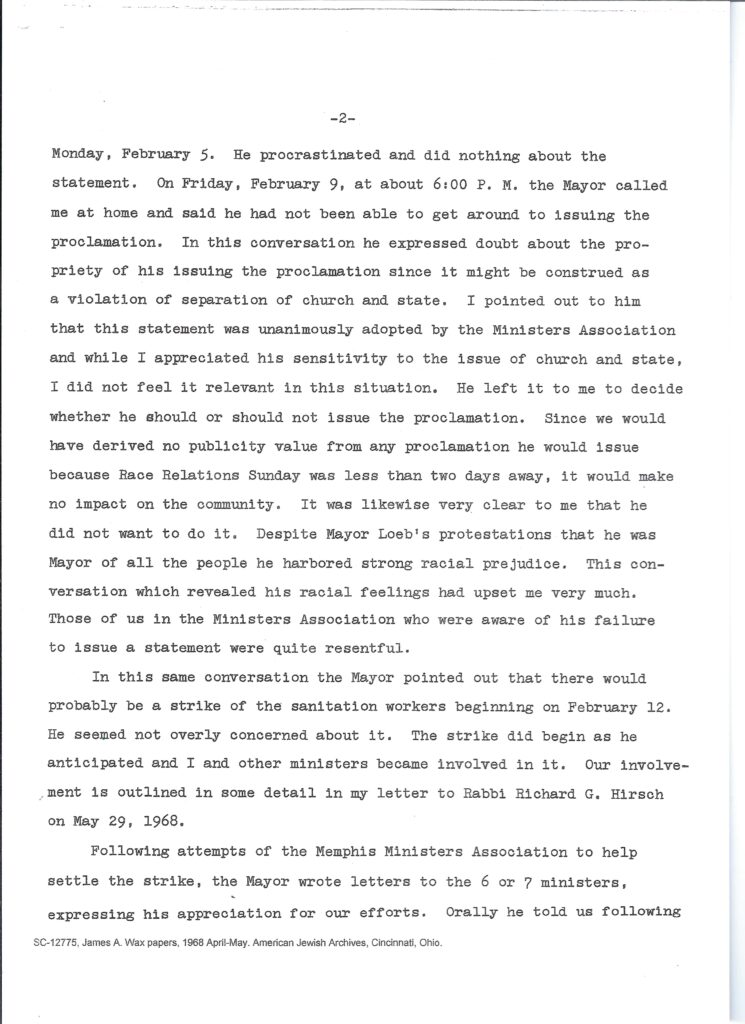
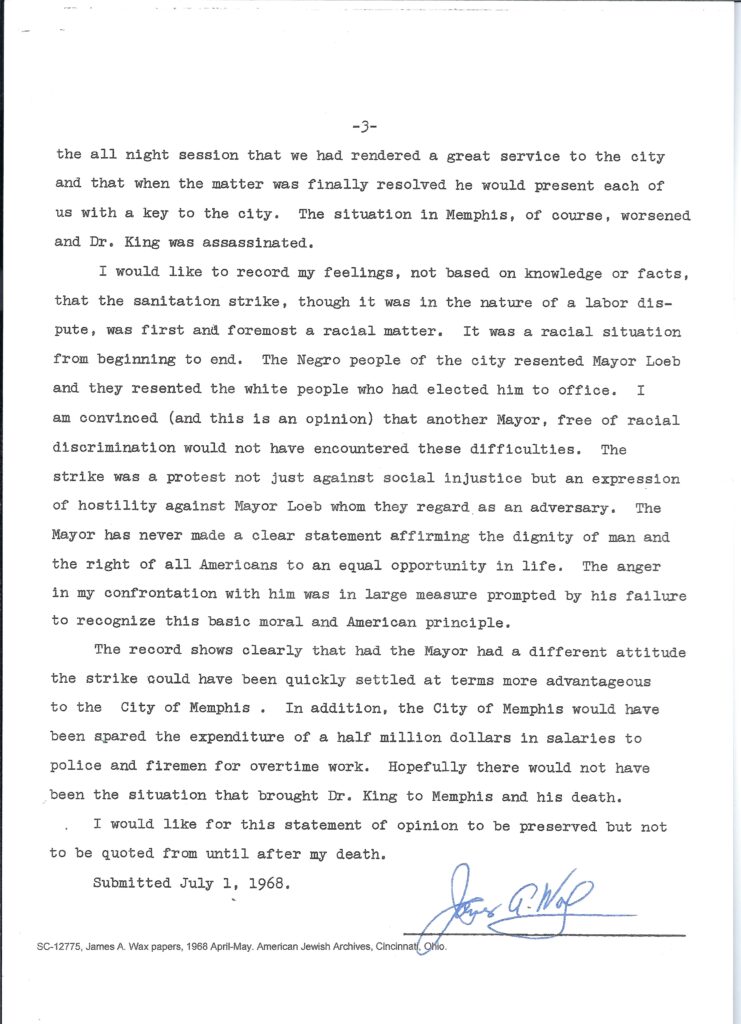
Rabbi Wax later reflected that the ministers got their first glimpse of Mayor Loeb’s true feelings when he did not issue a proclamation declaring Race Relations Sunday in early February.
“Despite Mayor Loeb’s protestations that he was Mayor of all the people, he harbored strong racial prejudice. Those of us in the minister’s association who were aware of his failure to issue a statement were quite resentful.”
Memphis sanitation and public works employees go on strike demanding decent living wage, safe working conditions, and recognition of their humanity and dignity
February 12, 1968
1968
1968
Rabbi Wax brings together Mayor Loeb and union members; Abe Plough offers to fund workers’ pay raises, but Loeb refuses
February 18, 1968

Letter from Mayor Loeb letter thanking ministers for their efforts
February 27, 1968
1968
Civil Rights Movement
After Dr. Martin Luther King Jr.’s assassination, tensions rose in Memphis as Rabbi Wax’s transformative shift challenged the city to confront civil rights, justice, and unity.
As Memphis faced escalating tensions in March 1968, Rabbi Wax’s stance shifted dramatically following Dr. King’s assassination. This led him to spearhead a historic march to City Hall and confront the mayor, a decision that echoed nationally.
Memphis grew increasingly tense during March 1968. Mayor Loeb’s refusal to recognize the union-organized strike was the catalyst that brought Dr. Martin Luther King Jr. to Memphis on April 3, the same day there was a call for the ministers association to join in a march to City Hall. Rabbi Wax declined to participate in the march, hoping that behind-the-scenes negotiations would resolve the strike.
All that changed when Dr. King was assassinated in downtown Memphis the following evening, April 4, 1968. “The picture changed as far as I was concerned and I decided to participate in the march and call on the mayor,” Rabbi Wax wrote in a letter to his college friend and colleague, Rabbi Hertz. The ministers association scheduled a memorial service for Dr. King at St. Mary’s Episcopal Cathedral for the next day.
After the service, the ministers voted to march to City Hall. As association president, Rabbi Wax led the 1.7-mile march with Dean William Dimmick of St. Mary’s and Rev. Henry Starks, pastor of St. James AME Church. They were followed by 250 clergymen and guarded by police officers in battle gear and police snipers positioned on rooftops along the route.
Rev. Frank McRae, then minister of St. John’s United Methodist Church, recalled that he put his hand on Rabbi Wax’s shoulder and said: “Slow down, Jimmy. I’m scared to death.” McRae said Rabbi Wax turned to him and replied, “So am I.” Inside the mayor’s office, Rabbi Wax’s inspired comments captured the attention of a national audience.
In the days following, Abe Plough, a Memphis businessman, philanthropist, and a Temple Israel congregant – without the knowledge of Rabbi Wax – offered to pay the sanitation workers’ pay raises, which helped bring the strike to a close. Mayor Loeb phoned Rabbi Wax and offered to park a police car at his house. Rabbi Wax declined the offer and apologized for raising his voice in their meeting. He did not apologize for the substance of what he said.
1968
Dr. King returns to lead a peaceful march supporting the sanitation workers in downtown Memphis; violence erupts
March 28, 1968
After returning to Memphis on April 3,
Dr. King is assassinated the next day, prompting major outbreaks of racial violence across the country
April 4, 1968
1968
“Social justice was a theme that came straight from the Hebrew Bible into the Scriptures, and one of our models for nonviolent resistance – justice, liberty, equality, and the beloved community. It’s what joined Rabbi Wax and me. For me, Rabbi Wax was a fellow prophet out of the Moses tradition, the Micah tradition. We treated each other as first cousins of the Hebrew prophets.”
— Rev. James M. Lawson, Jr.
1968
Rabbi Wax, on behalf of the Memphis Ministers’ Association confronts Memphis Mayor Henry Loeb about “God’s law”
April 5, 1968
“We come here this morning with a great deal of sadness in our hearts but also with a great deal of anger, sir. What has happened in our city is the result of injustice and oppression and lack of human decency and concern, for human beings shall be ruled with justice and justice for all. I realize we live in a society of law and order. We must have laws, but I would remind you most respectfully, sir, there are laws that are greater than the laws of Memphis and of Tennessee. The laws of God, and the laws of God are not subject to any Gallup poll. Speak out in favor of human dignity for every person. Let us not hide behind legal technicalities. Let us not wrap ourselves up in slogans. Let us do the will of God for the good of the city.”
— Rabbi James A. Wax

The Commercial Appeal, Memphis, TN

The Commercial Appeal, Memphis, TN
Civil Rights Movement
Rabbi Wax continues to support the Civil Rights movement writing a passionate sermon honoring Dr. King.
Rabbi Wax’s impassioned sermon on April 5, 1968, honoring Dr. Martin Luther King Jr., sparked intense reactions and a deluge of feedback, reflecting the deep divisions and challenges he faced in his pursuit of social justice.
“Martin Luther King . . . fought to break the chains that have oppressed people, he sought to give men dignity, he sought to make this a better world in which to live. Martin Luther King was one of the greatest men of this century because he personified the greatest teachings in Judaism and Christianity, and he did it without violence. He sought to appeal to the heart and the conscience of man.”
— Rabbi Wax sermon on the eve of Shabbat, April 5, 1968
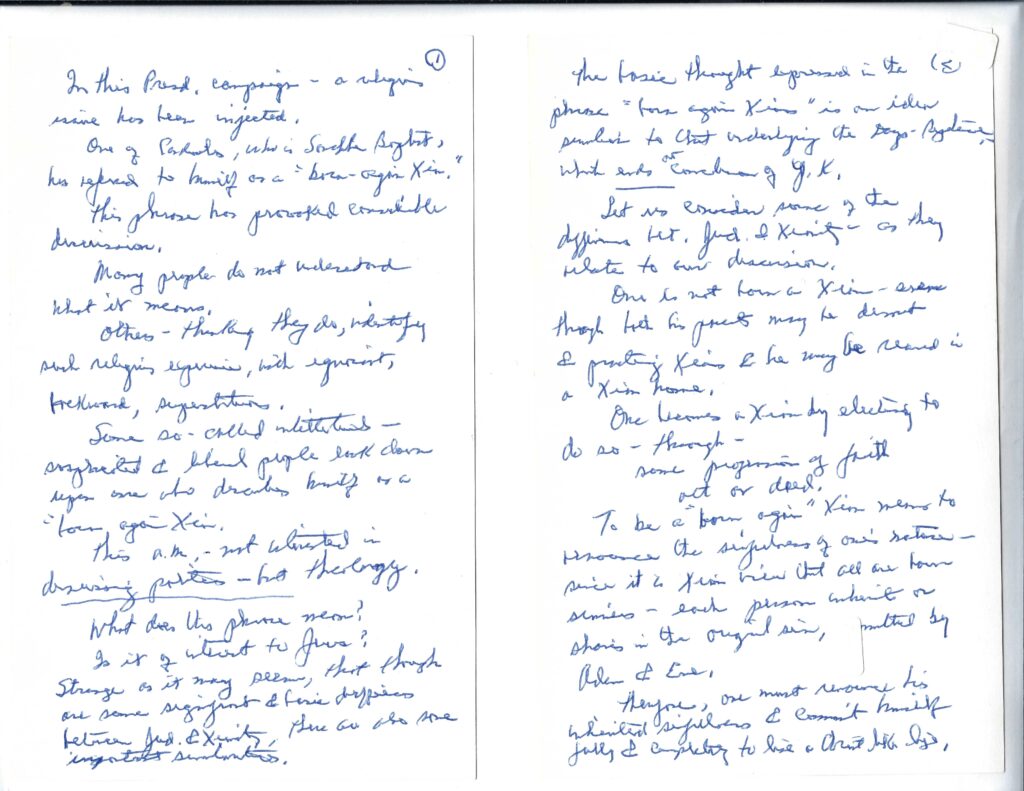
On the eve of Shabbat, April 5, 1968, only a few hours after his encounter with Mayor Loeb, Rabbi Wax delivered the briefest and, perhaps, most passionate sermon of his rabbinate.
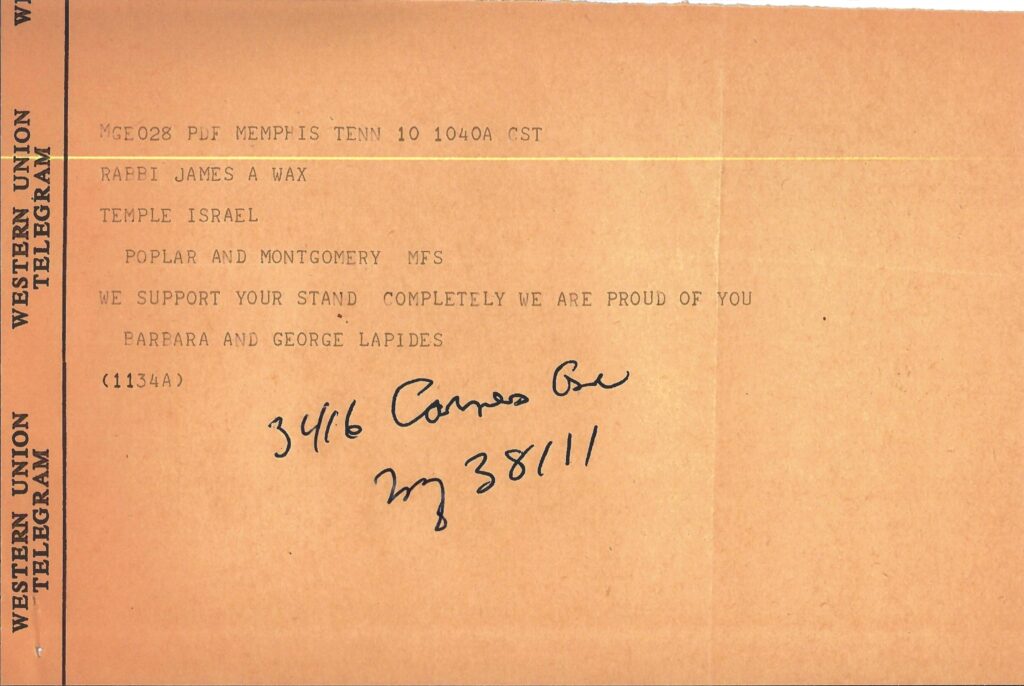
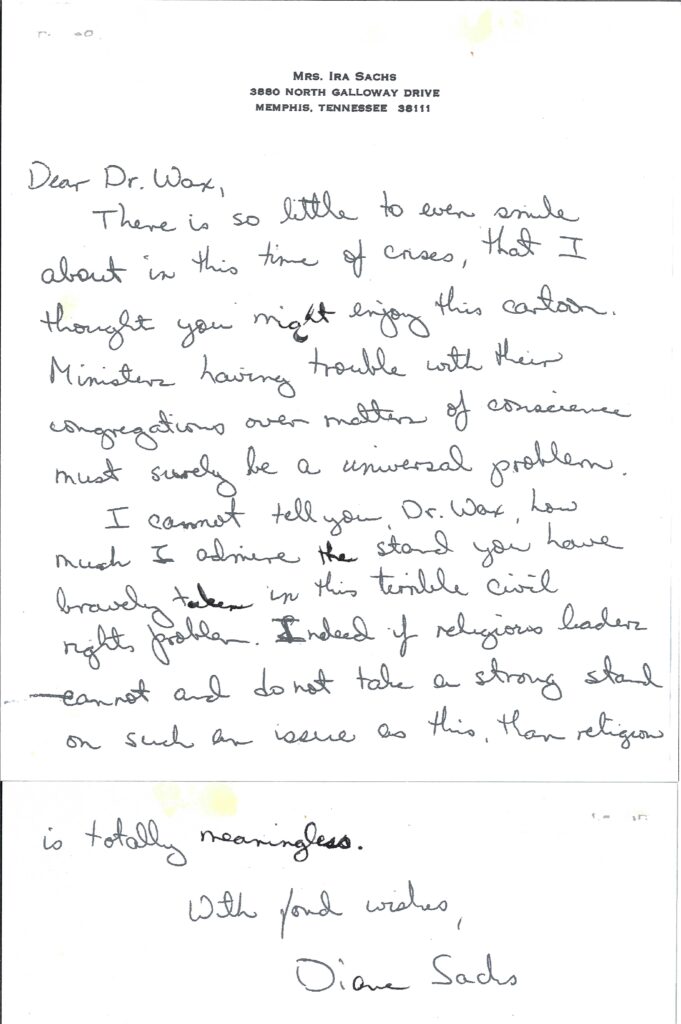
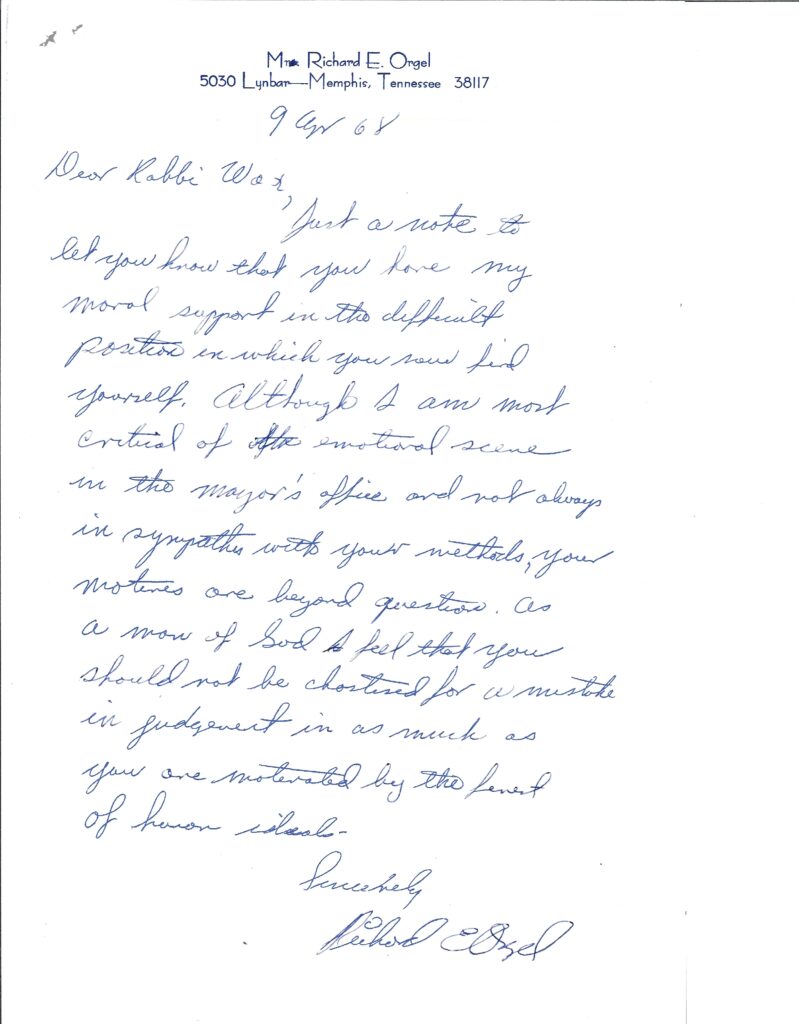
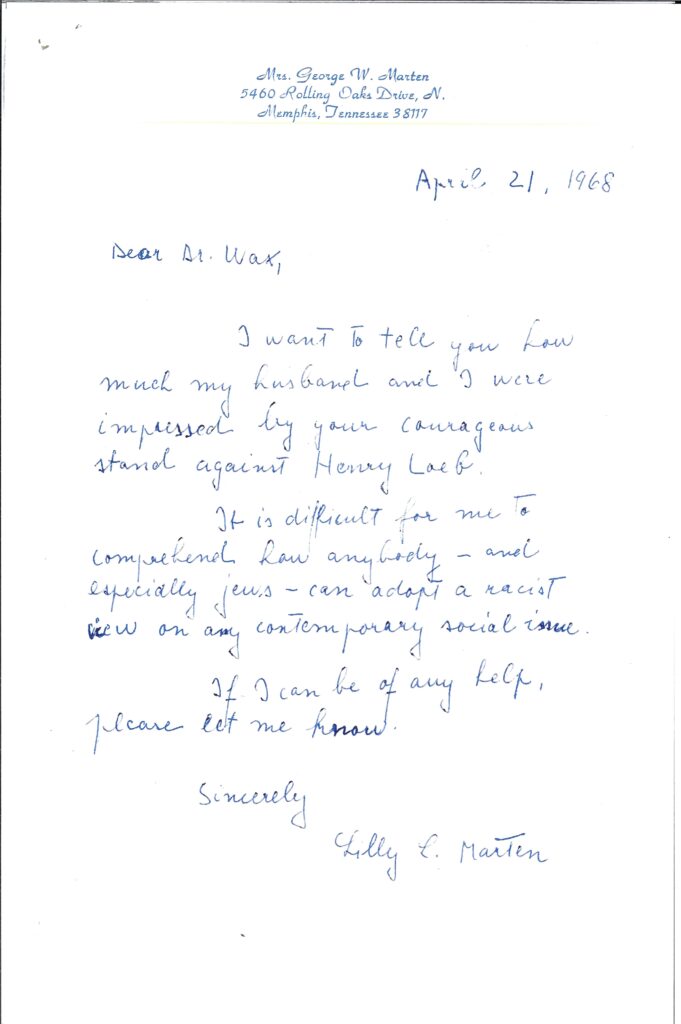
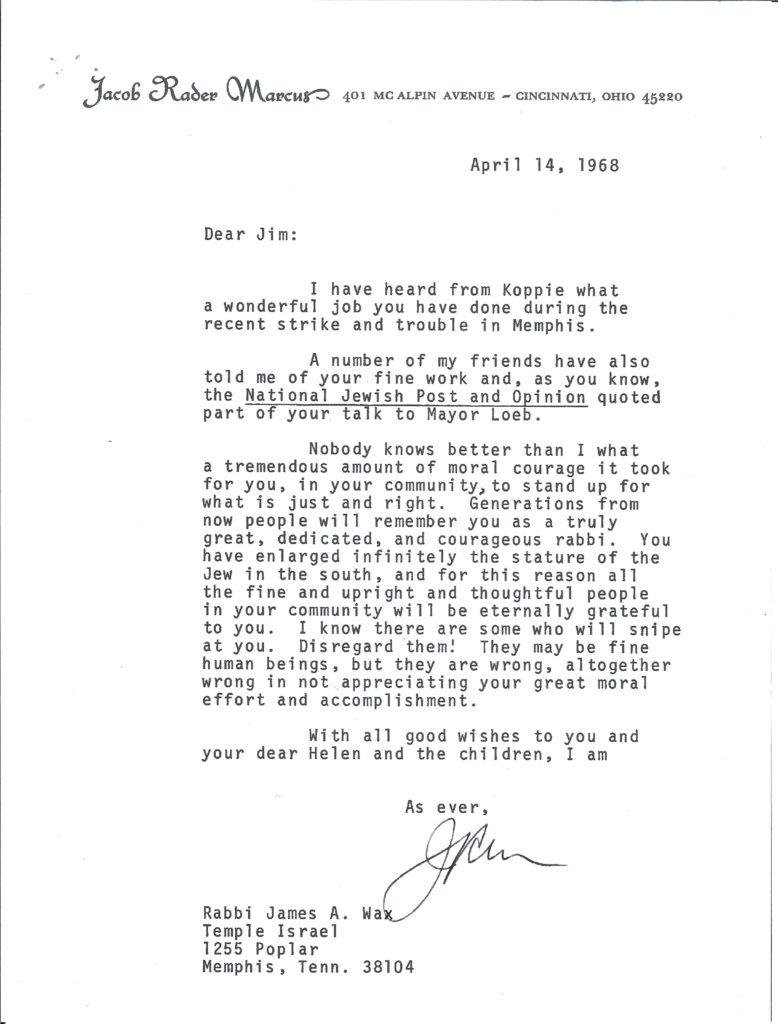
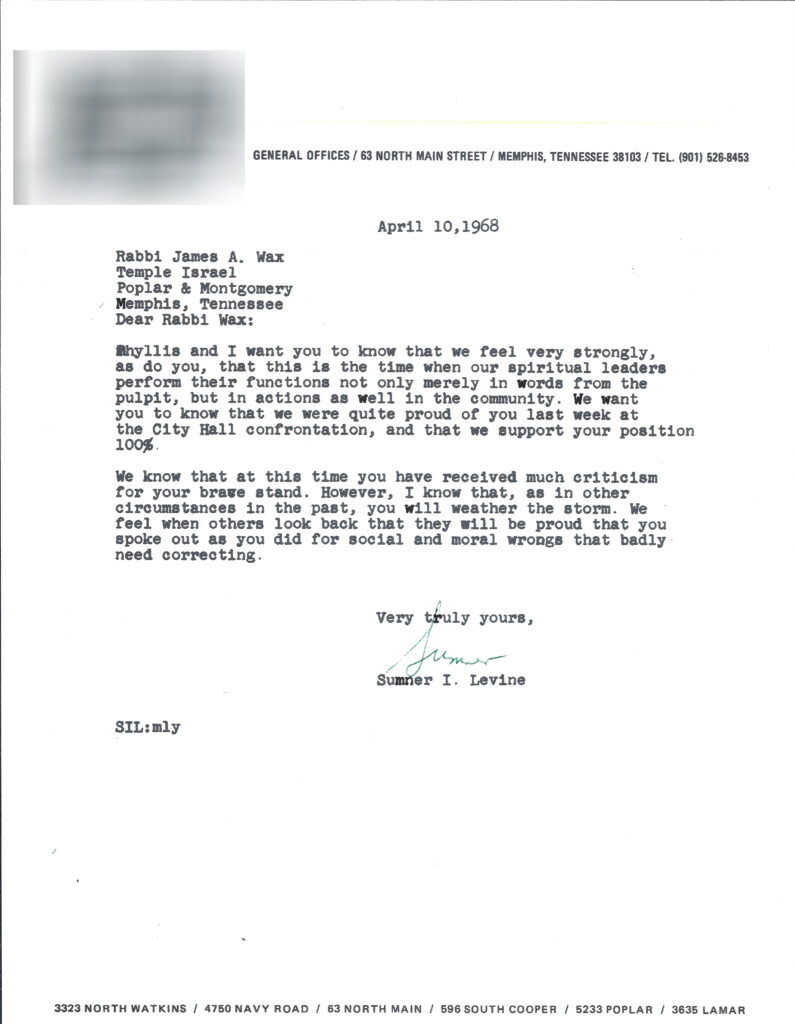
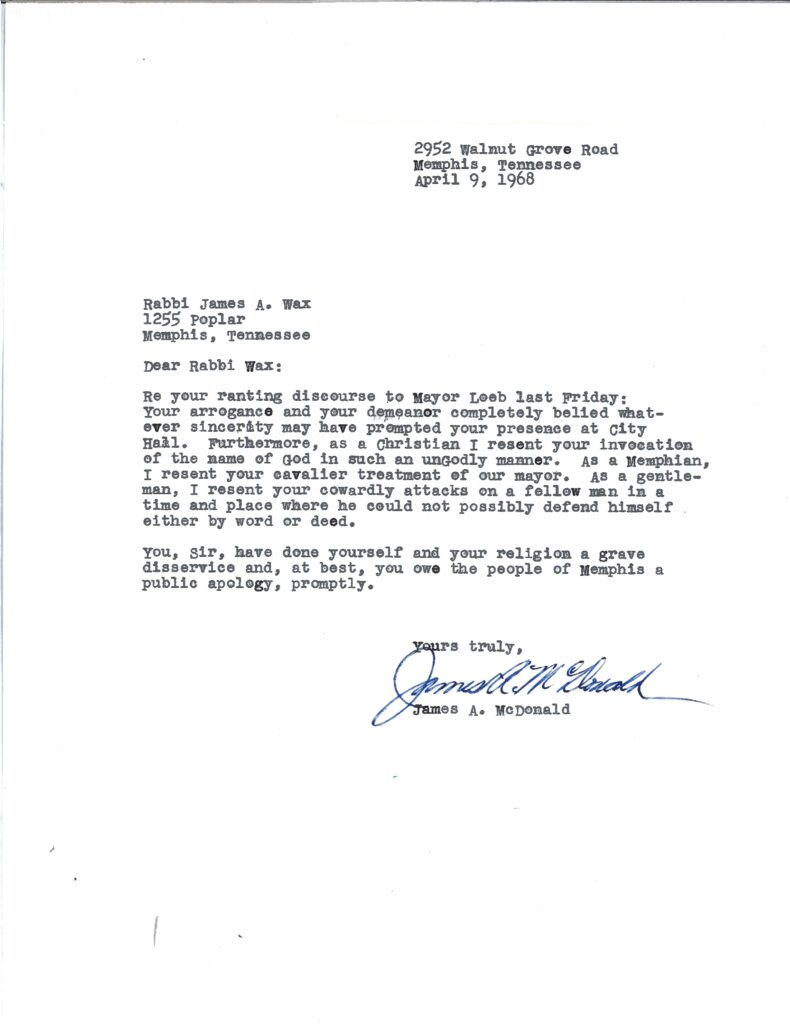
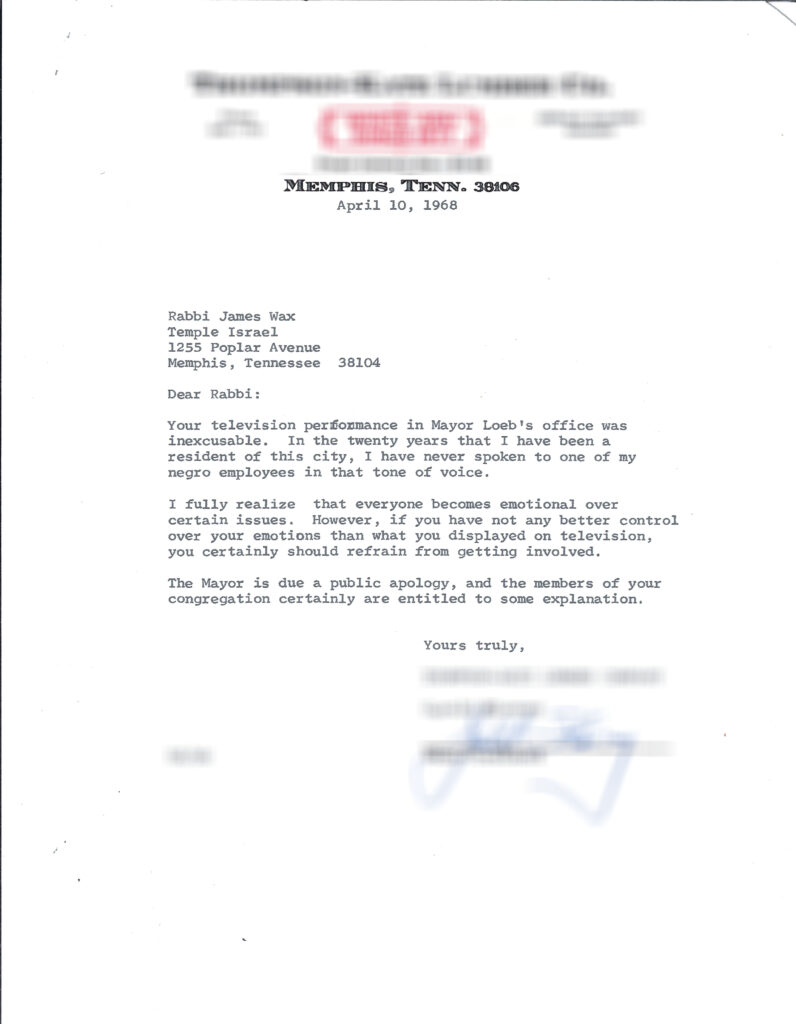
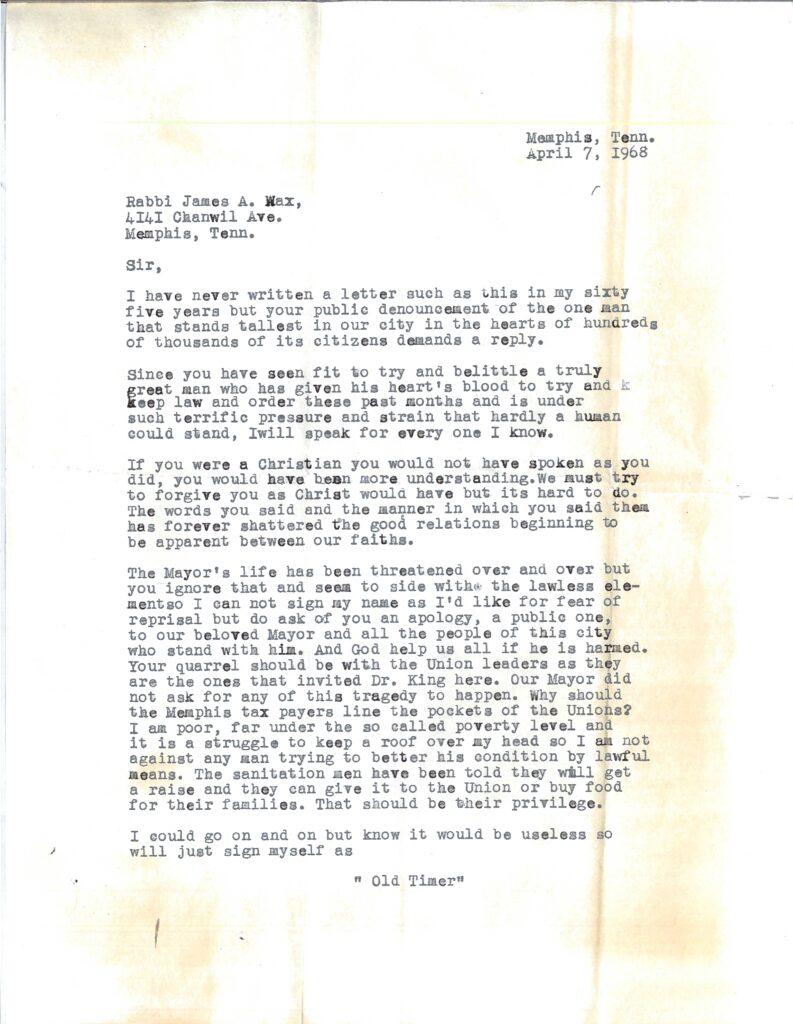
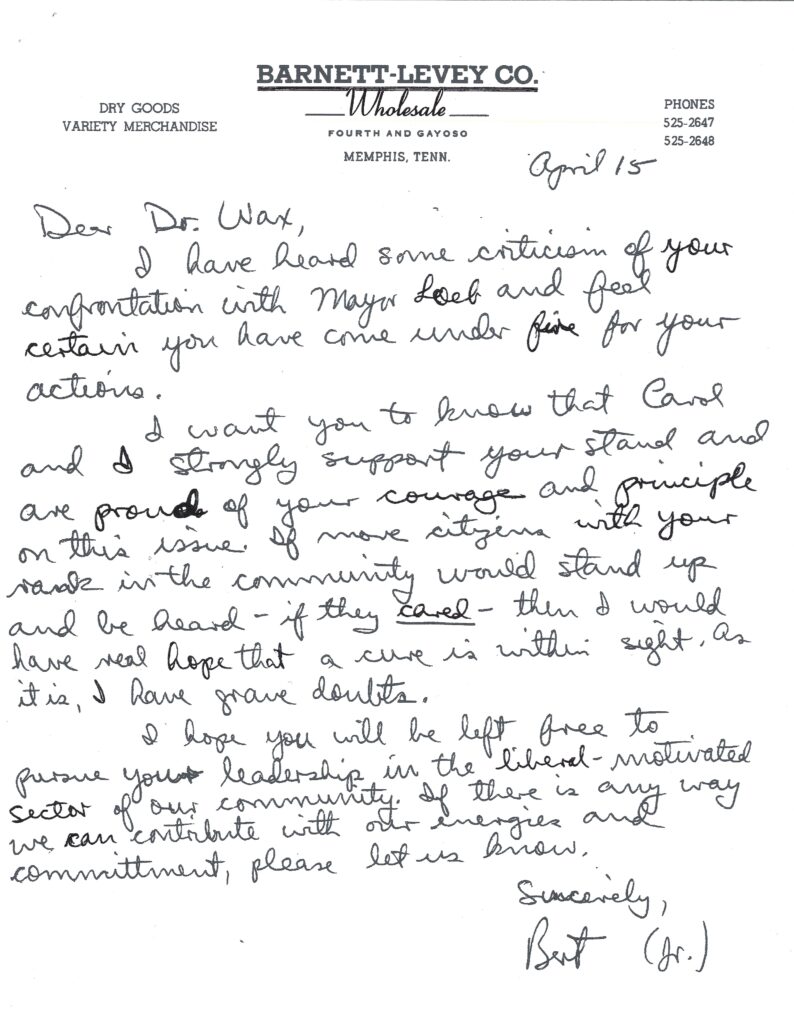
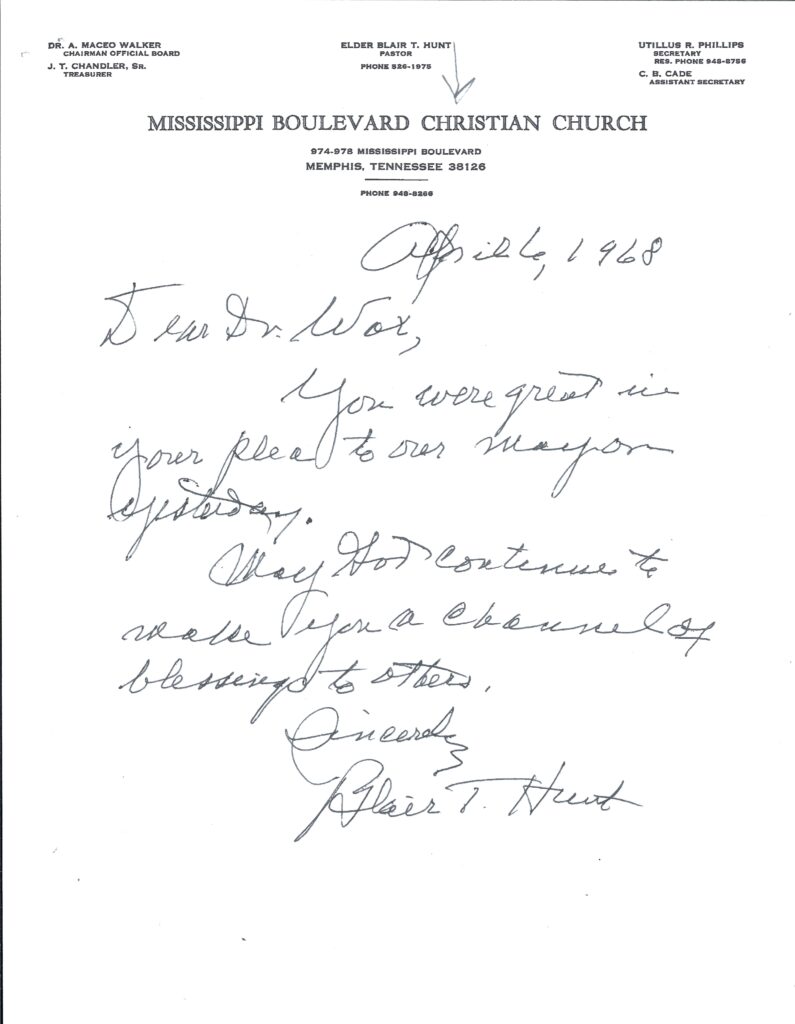
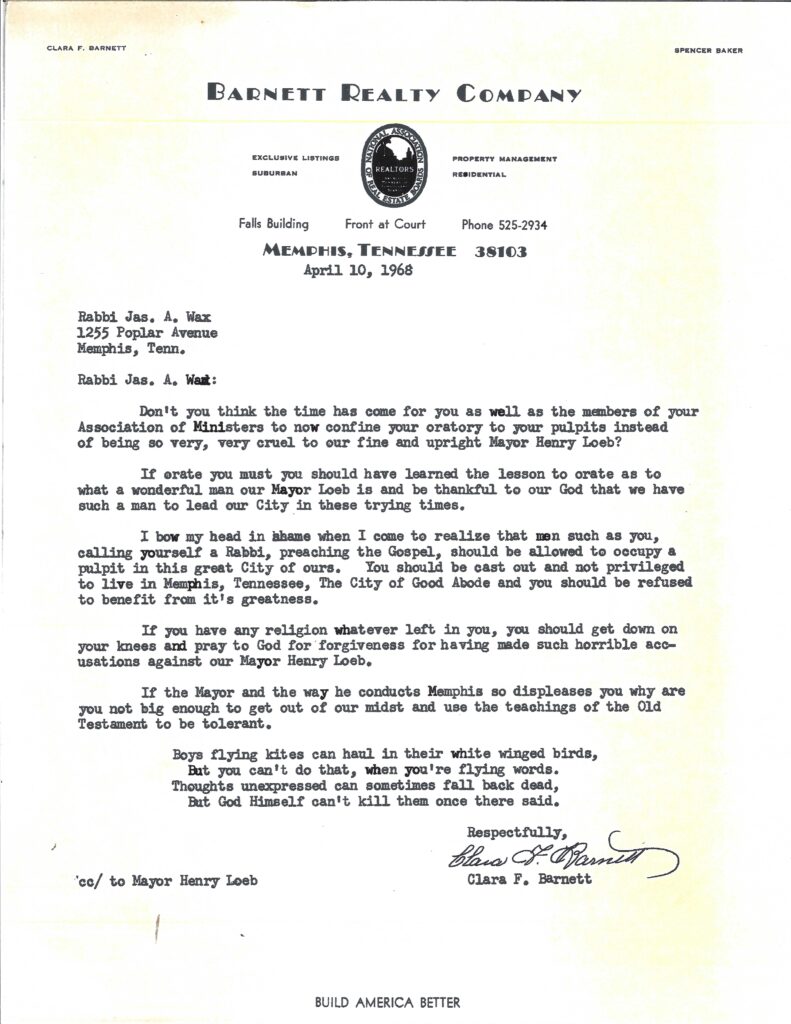
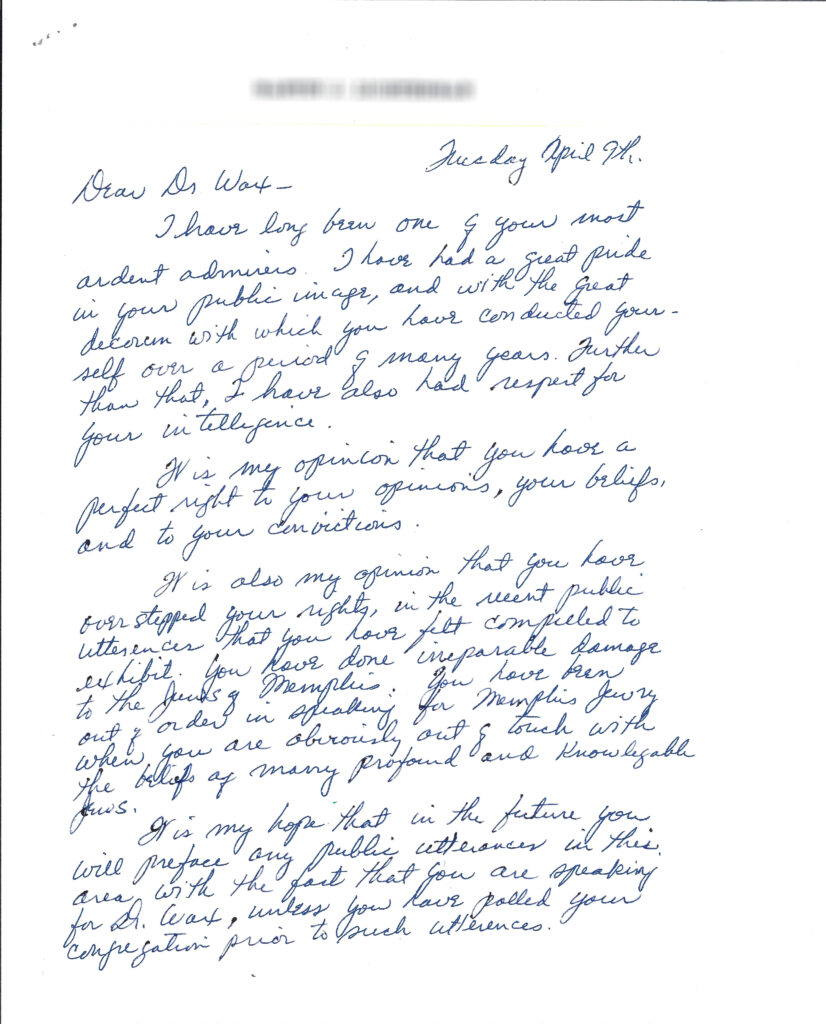
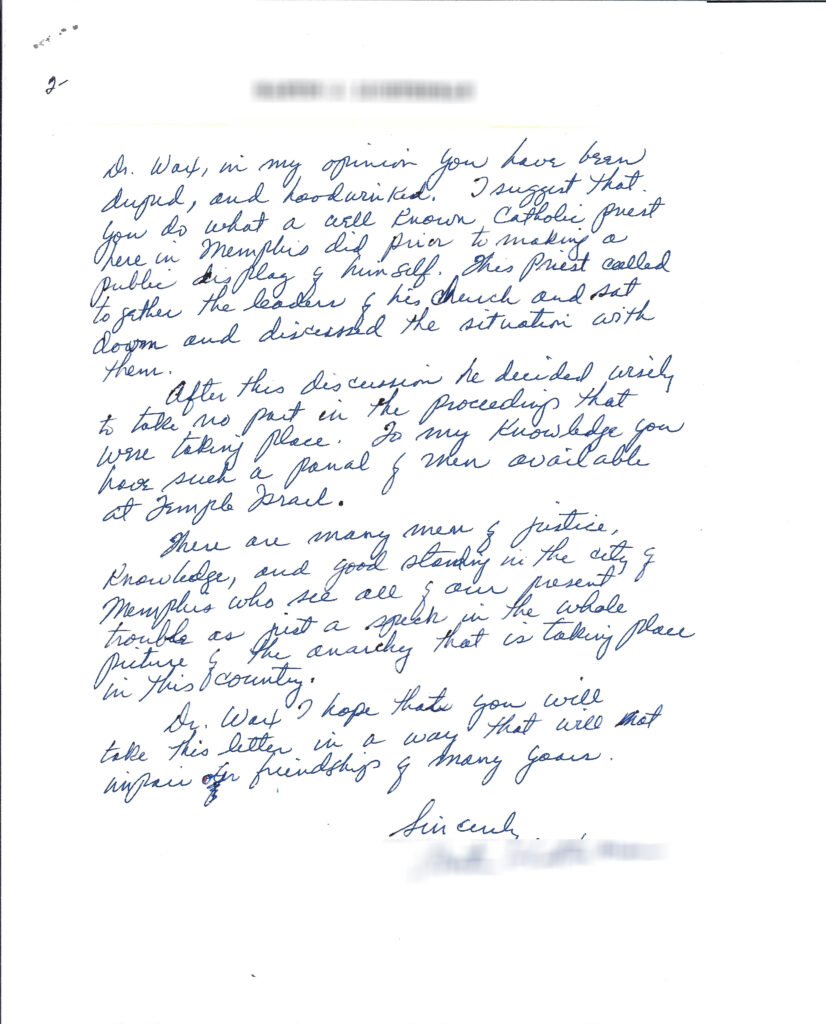
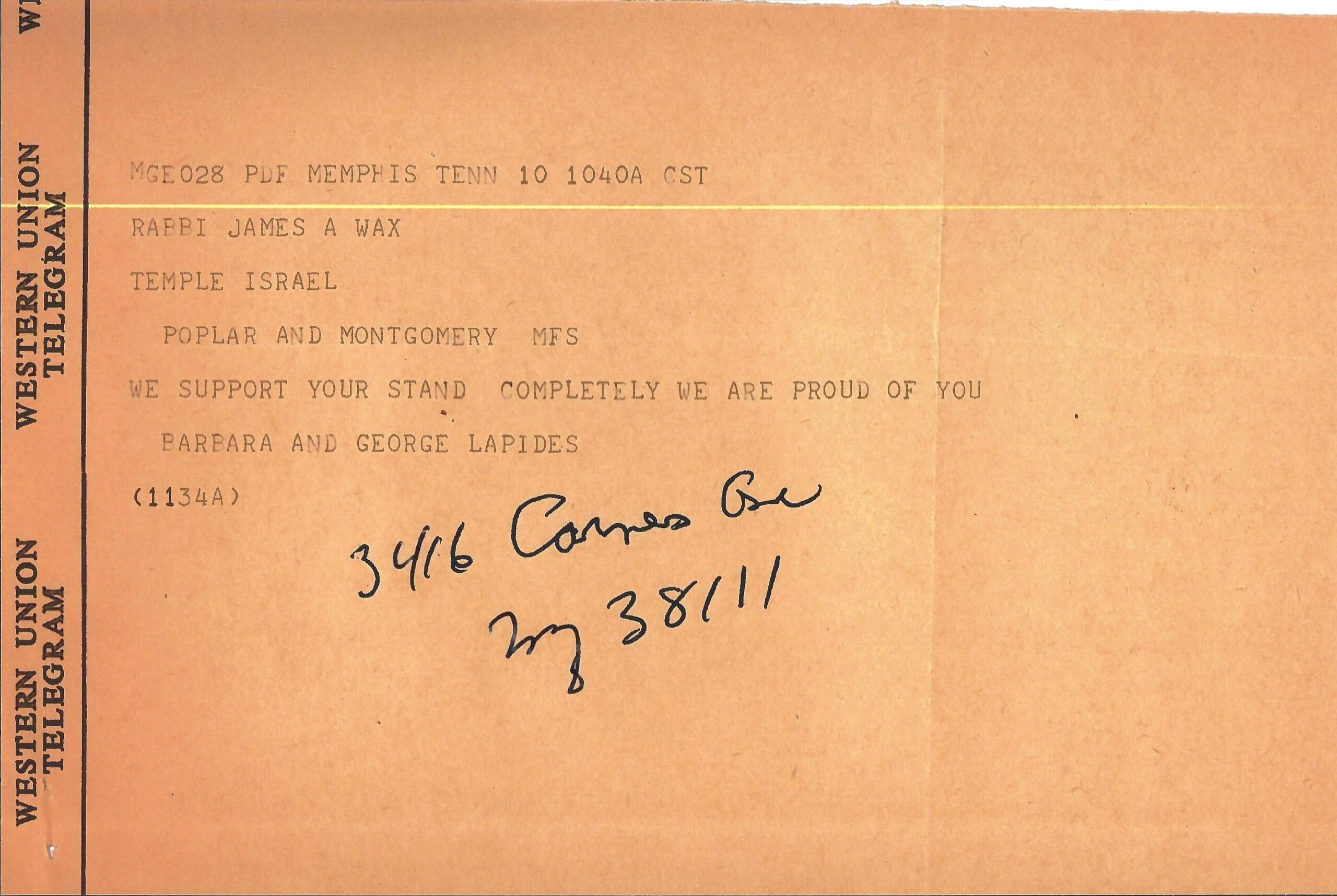
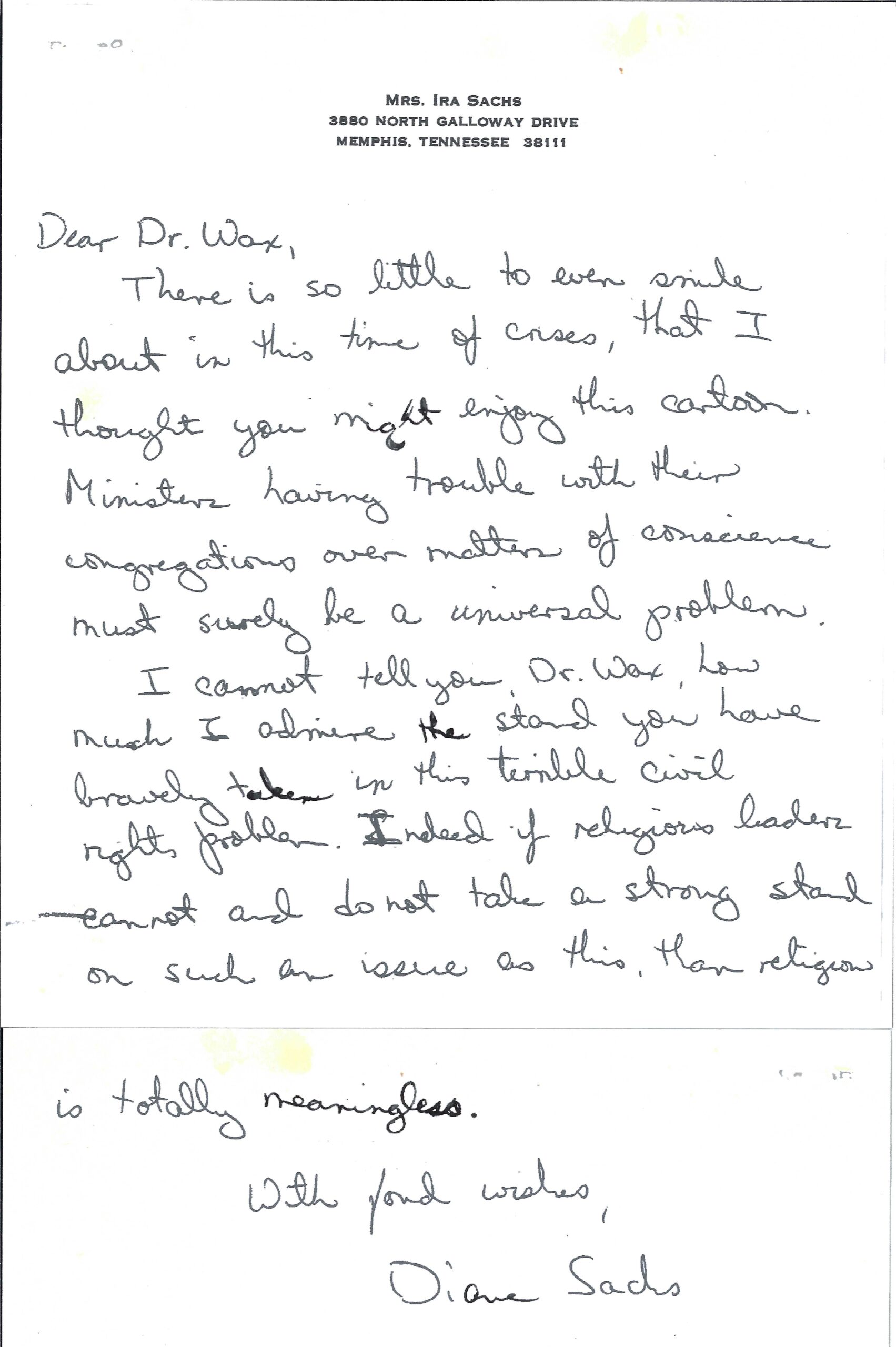
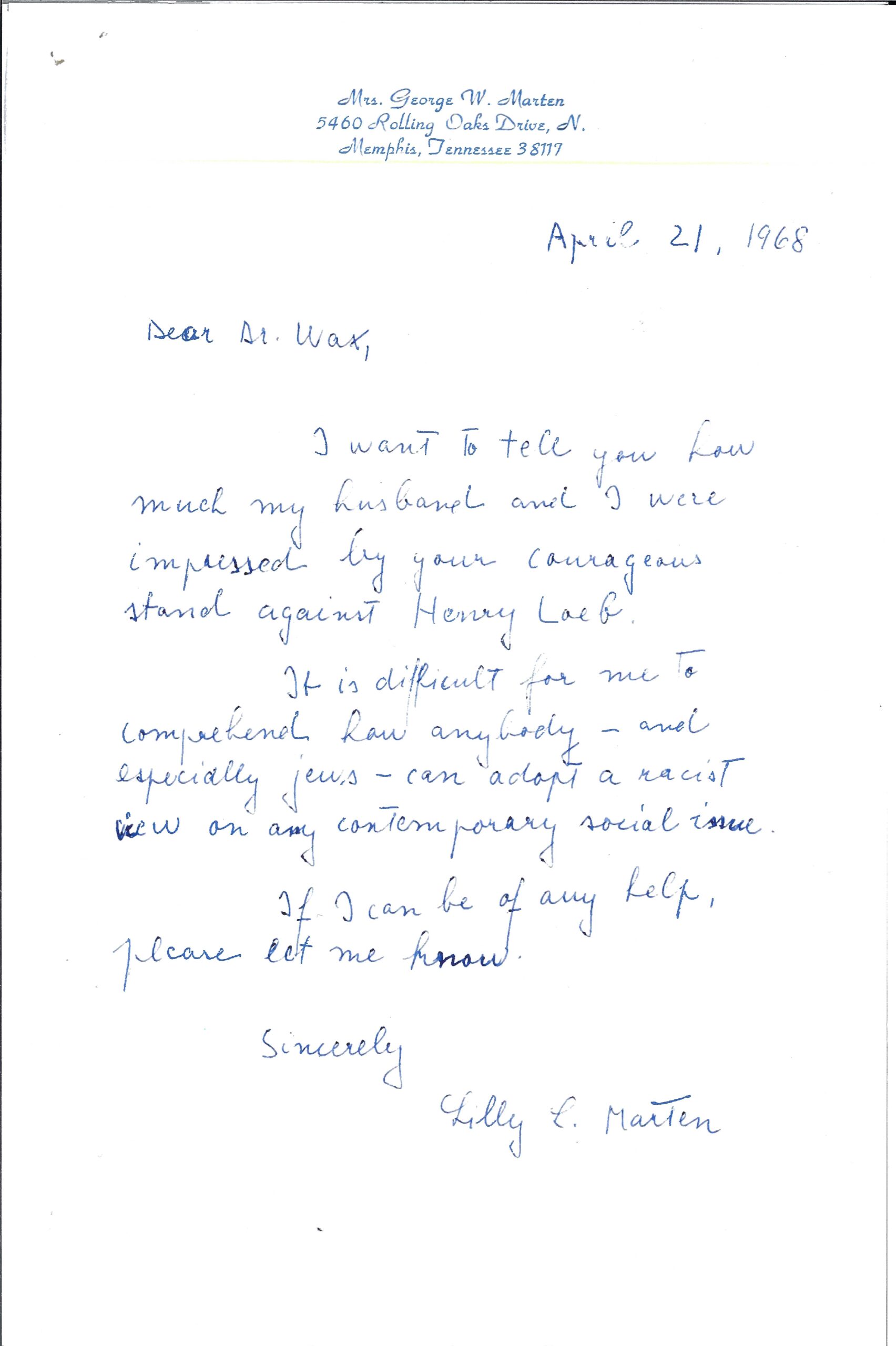
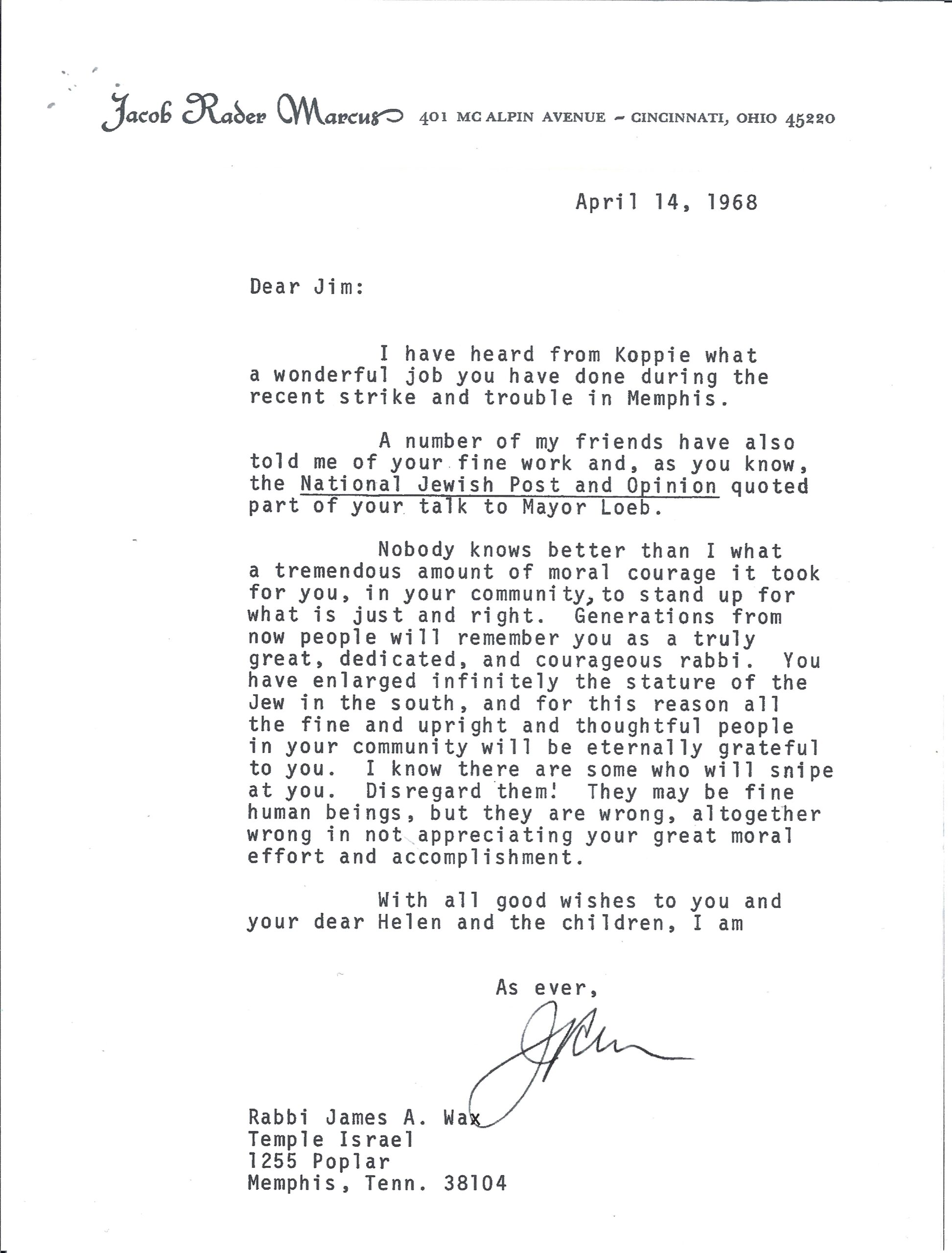
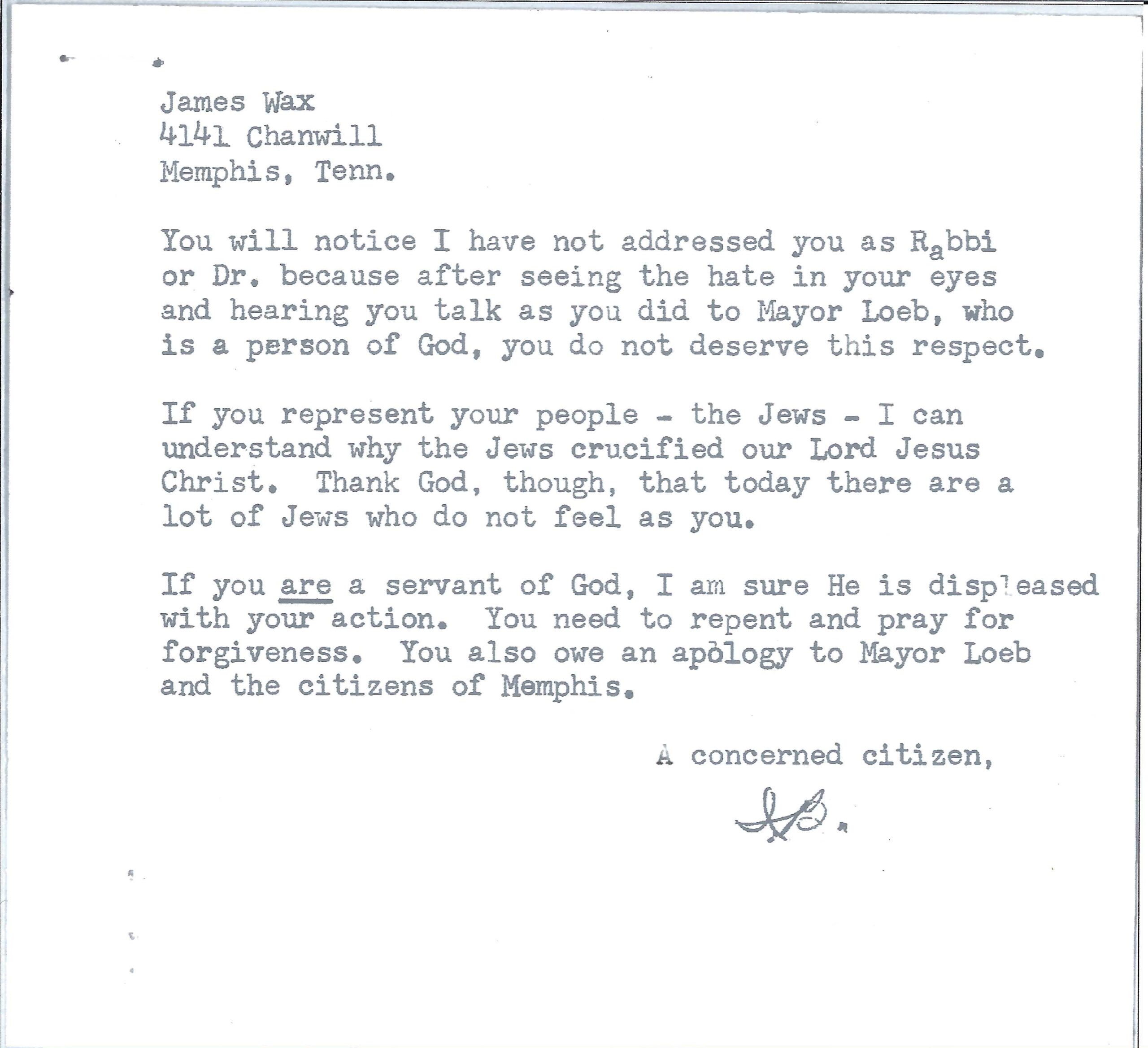
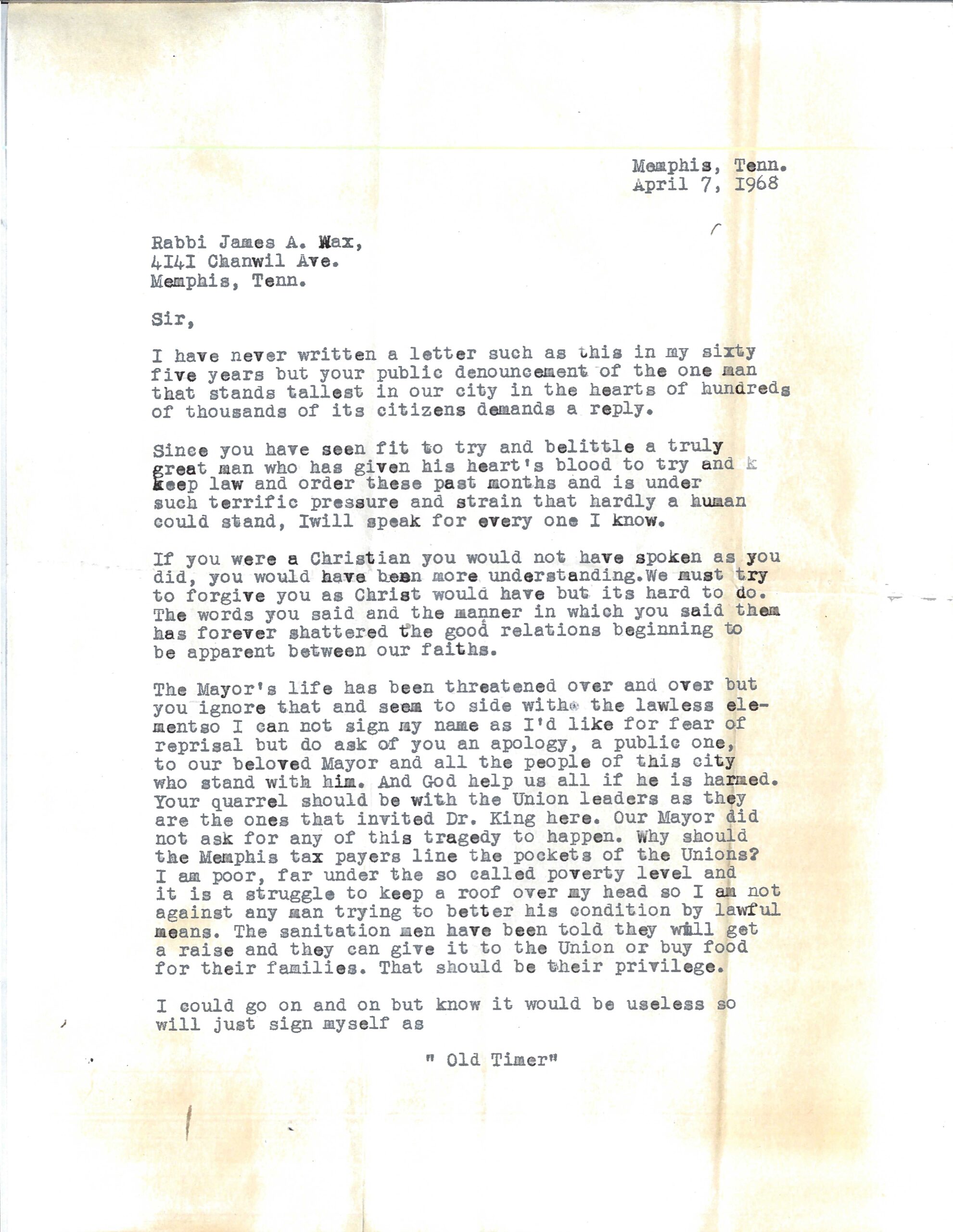
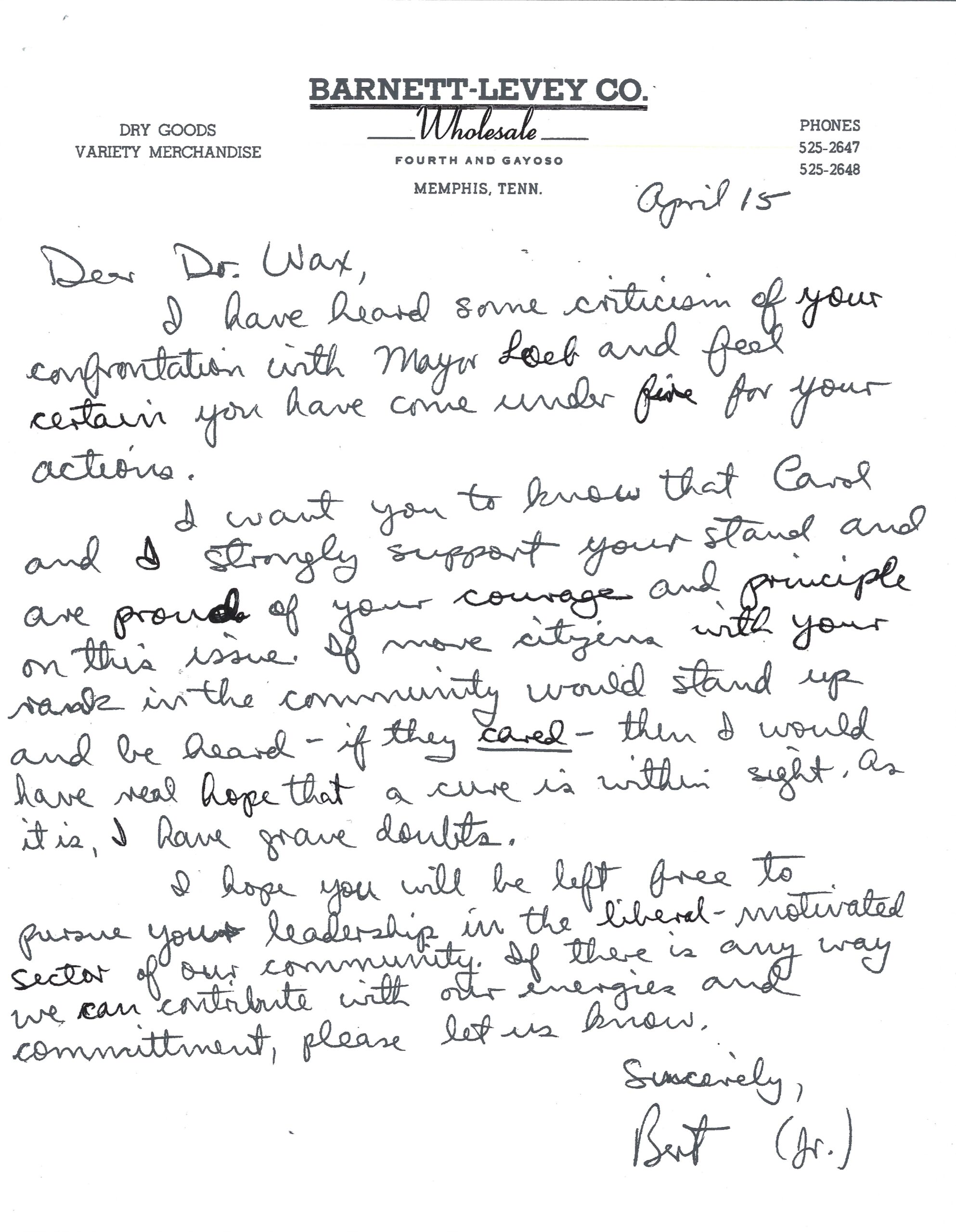
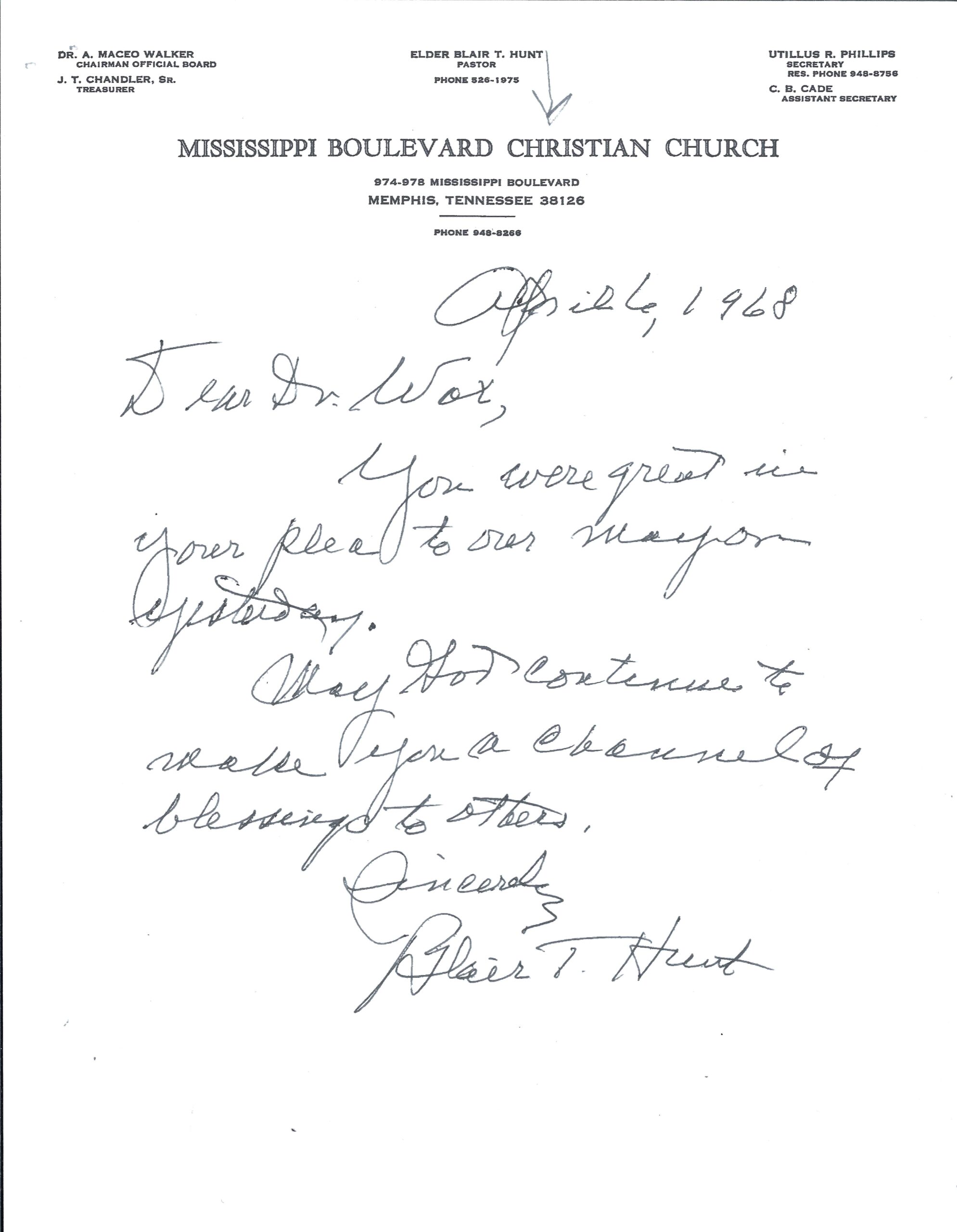
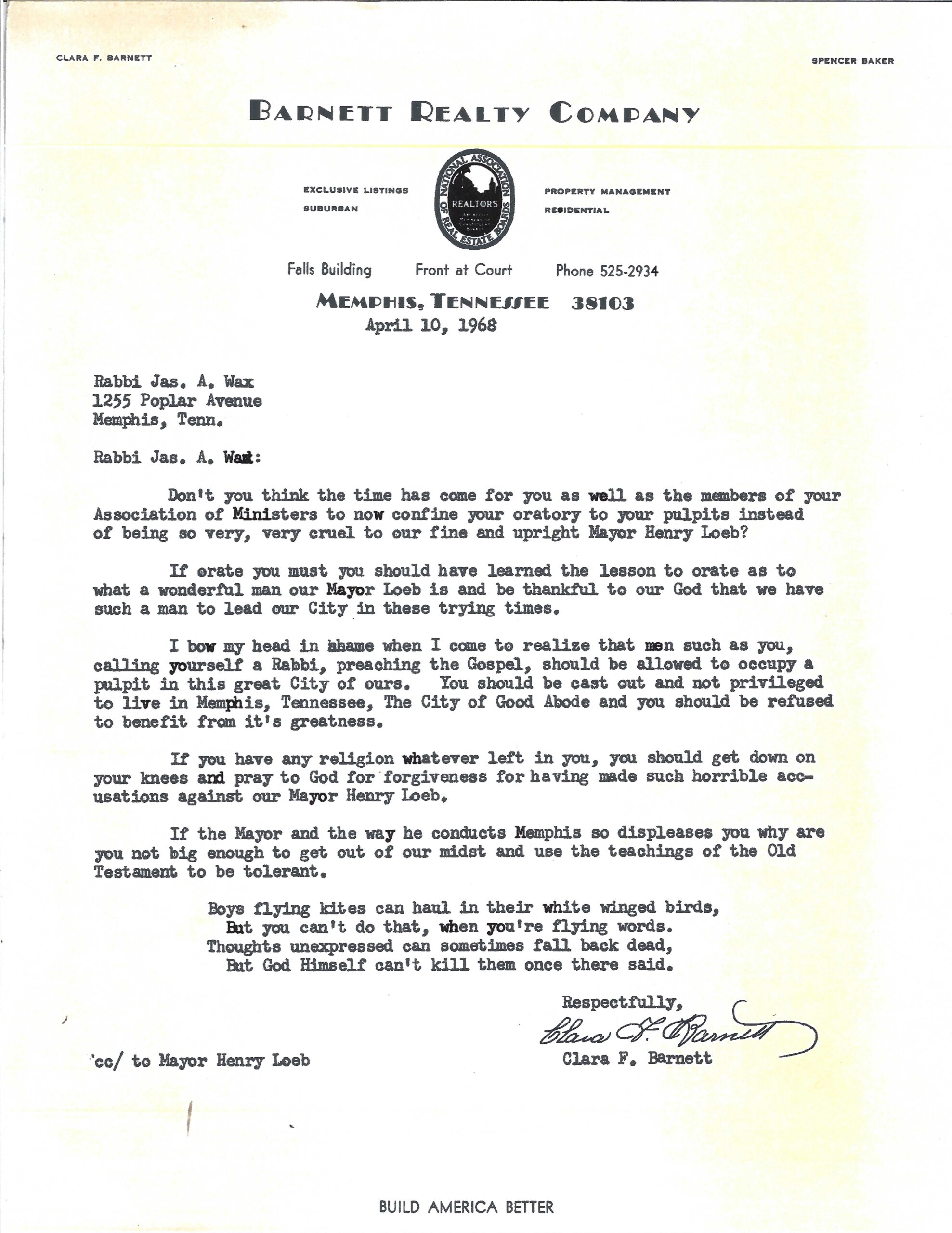
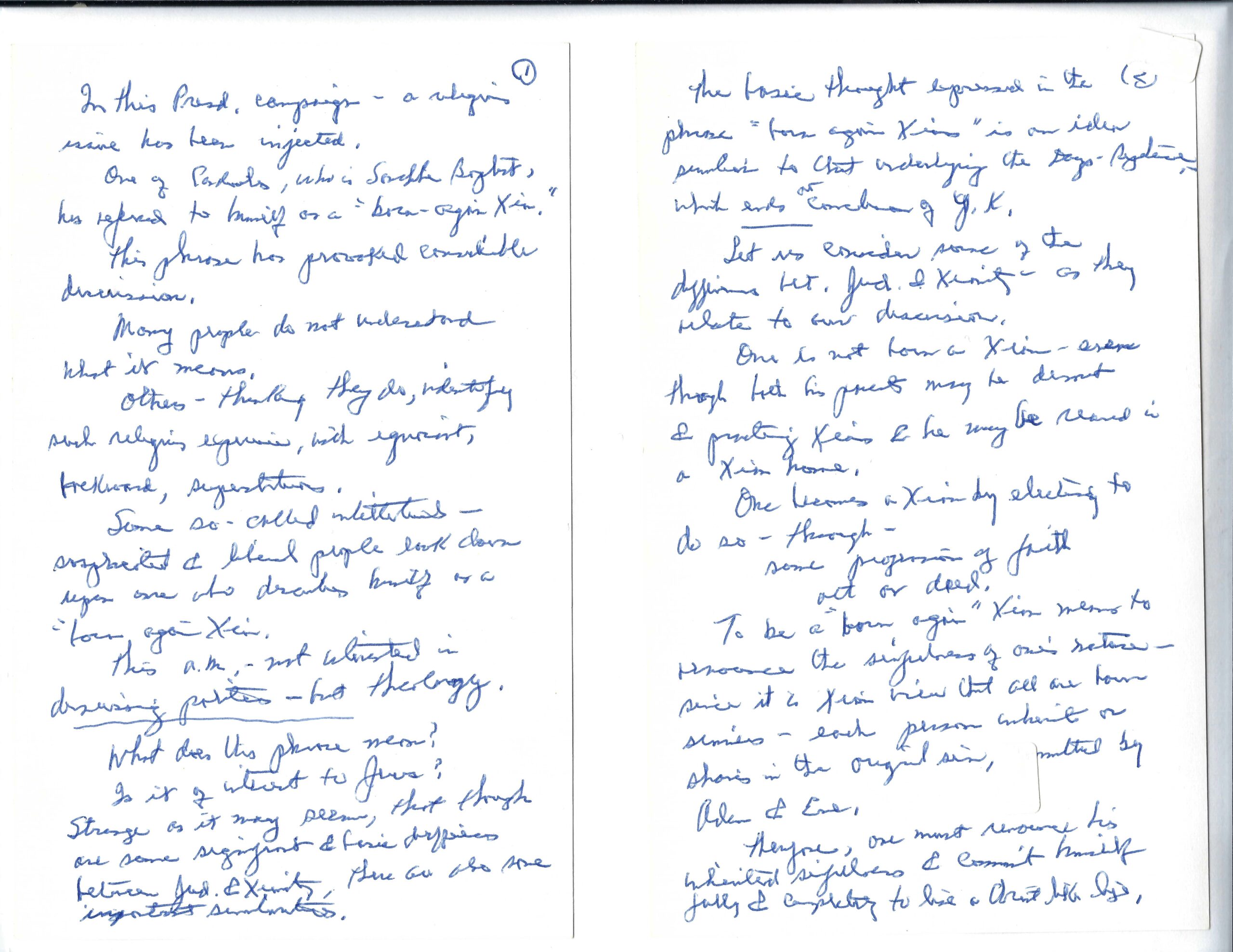
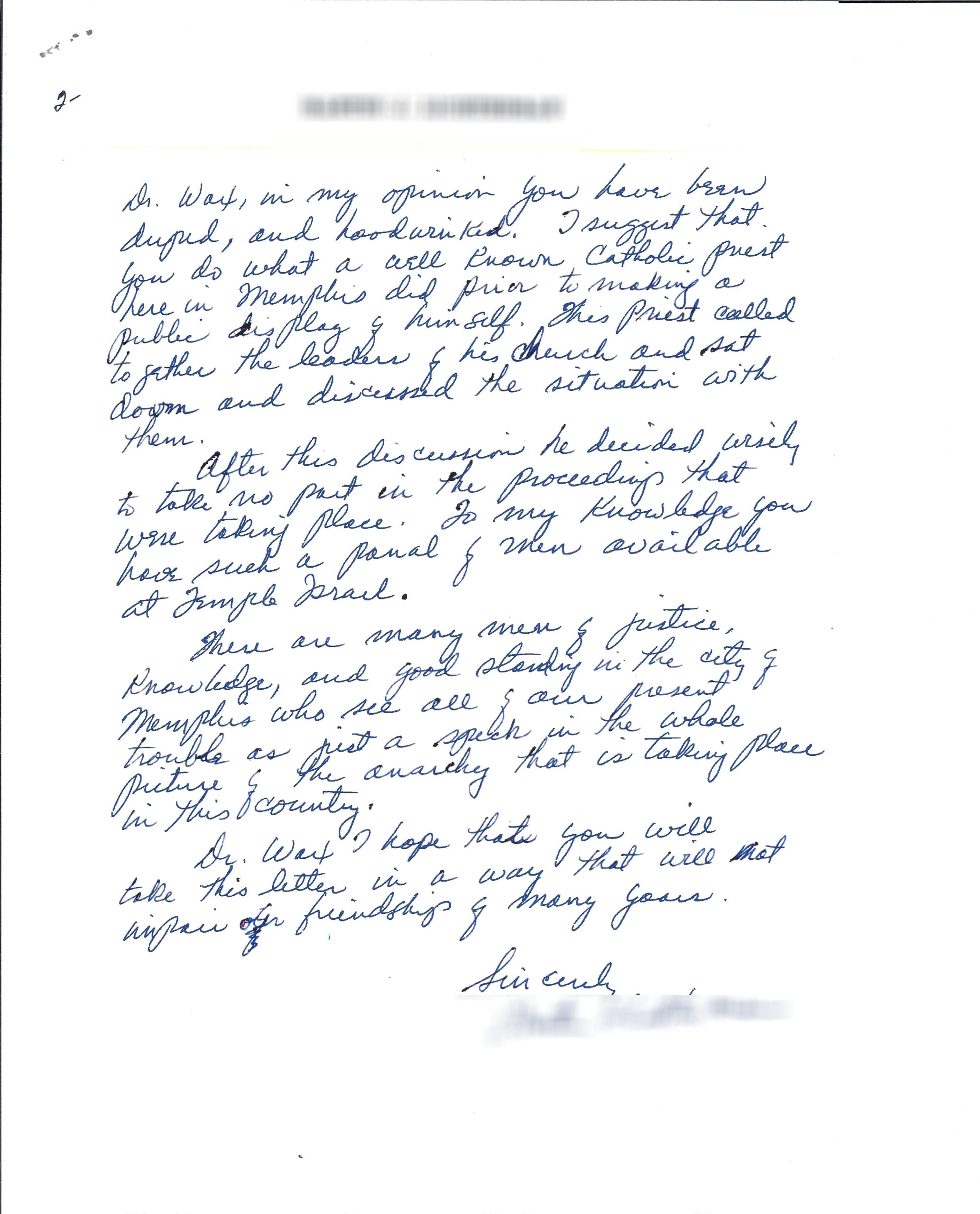
After his rebuke of the mayor, Rabbi Wax received an avalanche of phone calls and letters. He sent those letters to the American Jewish Archives, perhaps for safekeeping or perhaps to protect his critics and future generations. There are 121 letters criticizing his encounter with Mayor Loeb, and 81 in support.
“Very few made reference to the racial aspect of the situation,” Rabbi Wax recalled. “There were, of course, a large number of calls and many letters supporting my position, from members of the congregation and many Christian people. The number of letters and calls supporting my position did not equal those who were against it.”
“Then came the mail, violent and threatening. For weeks we would not keep our phone on at night for the ugly messages – or just silence. Other so-called friends stopped speaking to us and there were some angry Temple members. However, our Temple’s long policy of ‘freedom of the pulpit’ prevailed and the Board of Trustees refused to consider or discuss requests that the Rabbi should be fired. He had no contract so he could have been. Several (Memphis) ministers lost their pulpits over their participation.” — Helen Wax

April 12, 1968
1968


Civil Rights Movement
Rabbi Wax reflects on Dr. King’s death marking a significant shift in Wax’s activism.
Reflecting on his emotional response to Dr. King’s death, Rabbi Wax acknowledged his impassioned approach, while his colleague, Rabbi Danziger, highlighted the complex and dangerous times that followed, marking a significant shift in Wax’s approach to activism.
Weeks later, Wax reflected in a letter to a fellow rabbi: “My own remarks, which were carried by national television, were very emotional and impassioned. There was some criticism of the manner in which I spoke. I’ll admit I was needlessly emotional. It should have been more restrained, but the circumstances were such that I couldn’t do differently.”
For months after Dr. King’s death, when Rabbi Wax stood on the pulpit, Temple Israel Rabbi Emeritus Harry Danziger, Rabbi Wax’s assistant rabbi at the time, sat behind him and kept his eyes on the entrance to the sanctuary “because this was a dangerous time.”
Rabbi Danzinger said of his colleague:
“This was not in his mind his finest hour. He was not a marcher. He didn’t go to demonstrations. He believed problems should be solved by leaders coming together and making decisions, which is how a lot worked in Memphis prior to this. For him, the fact that all of this took place with the sanitation strike was a deep disappointment, even though for many people, this was his finest hour.”
1968
President Lyndon B. Johnson charges Undersecretary of Labor James Reynolds with negotiating a solution, ending the Memphis Sanitation Workers’ Strike
April 16, 1968
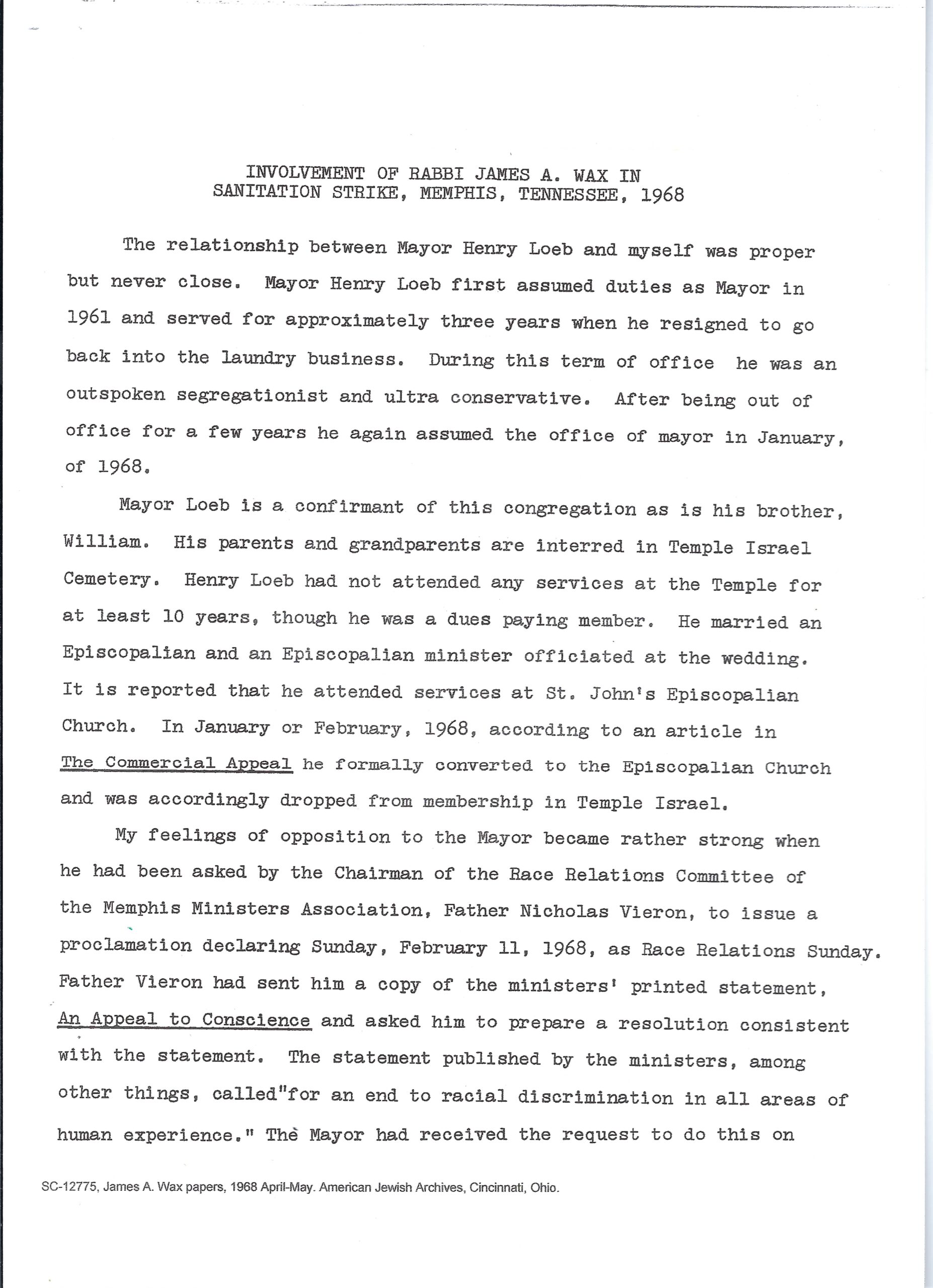
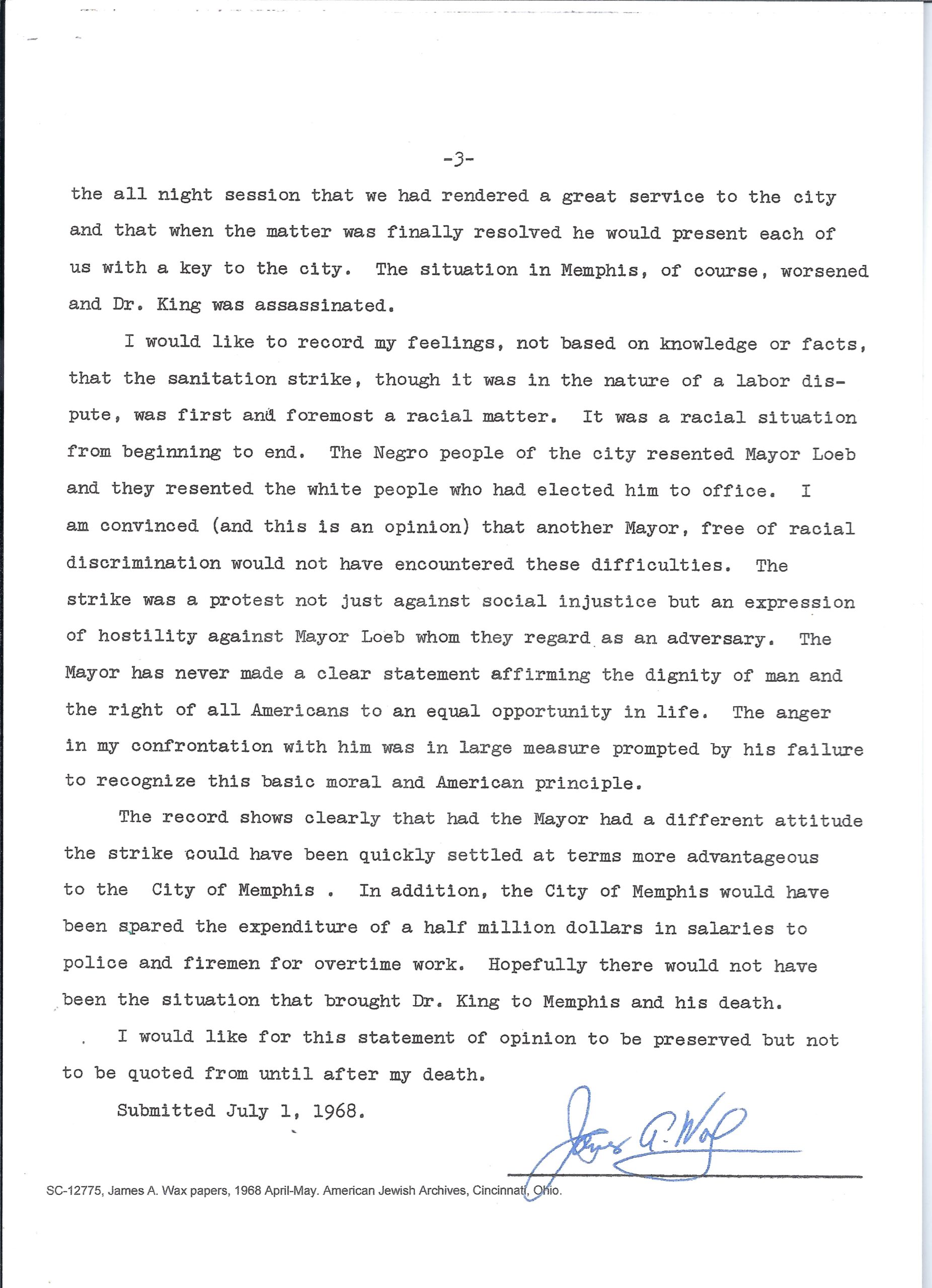
Nearly three months after Dr. King’s death, Rabbi Wax dictates a three-page summary of his involvement to be sealed and opened after his death
July 1, 1968
1968
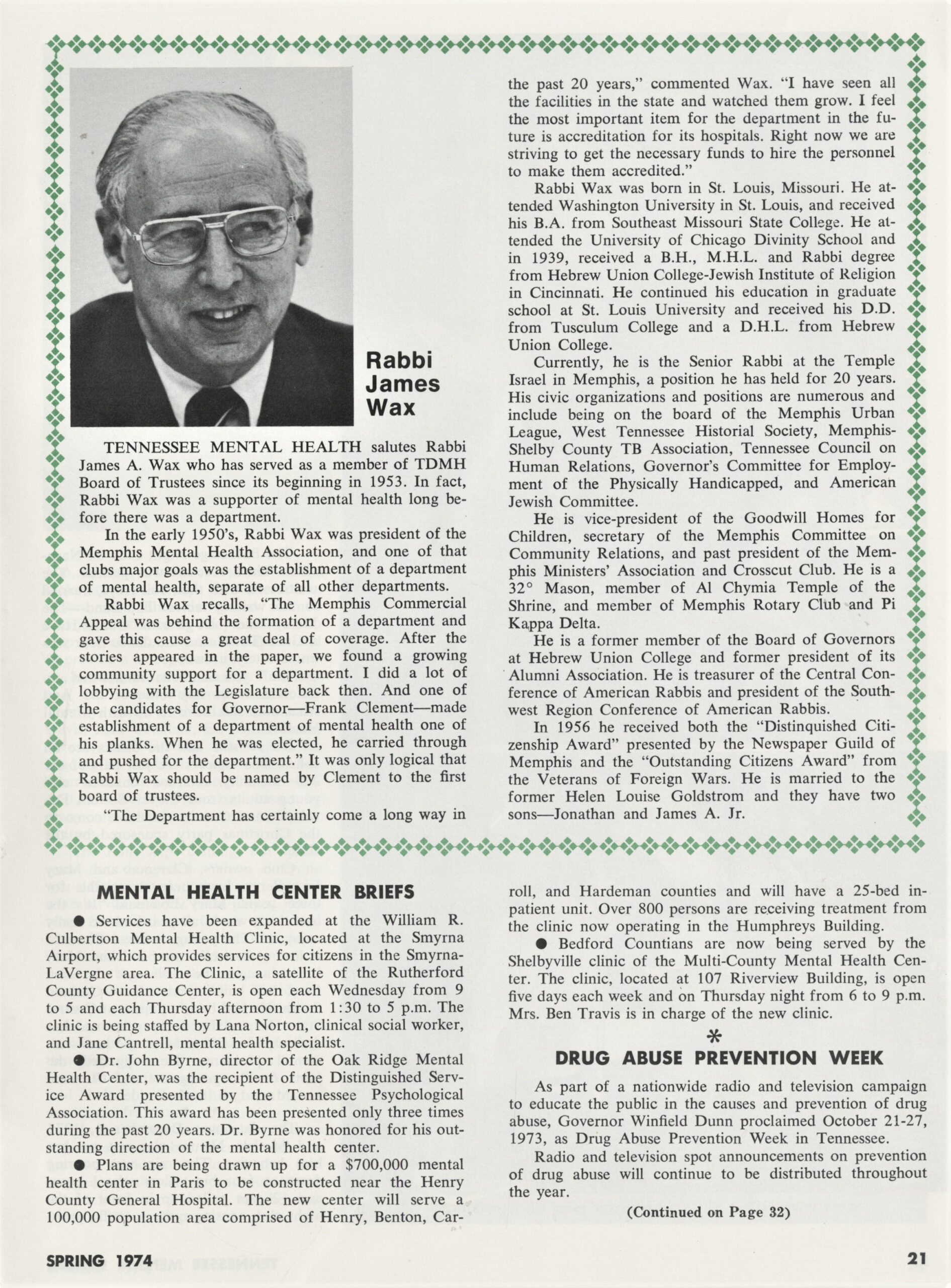
Rabbi Wax was elected president of the newly formed Memphis-Shelby County Mental Hygiene Society in 1950. The organization recognized his outspoken advocacy for mental health issues at a time when seeking help was considered by many a societal shame. Rabbi Wax became a dedicated advocate.
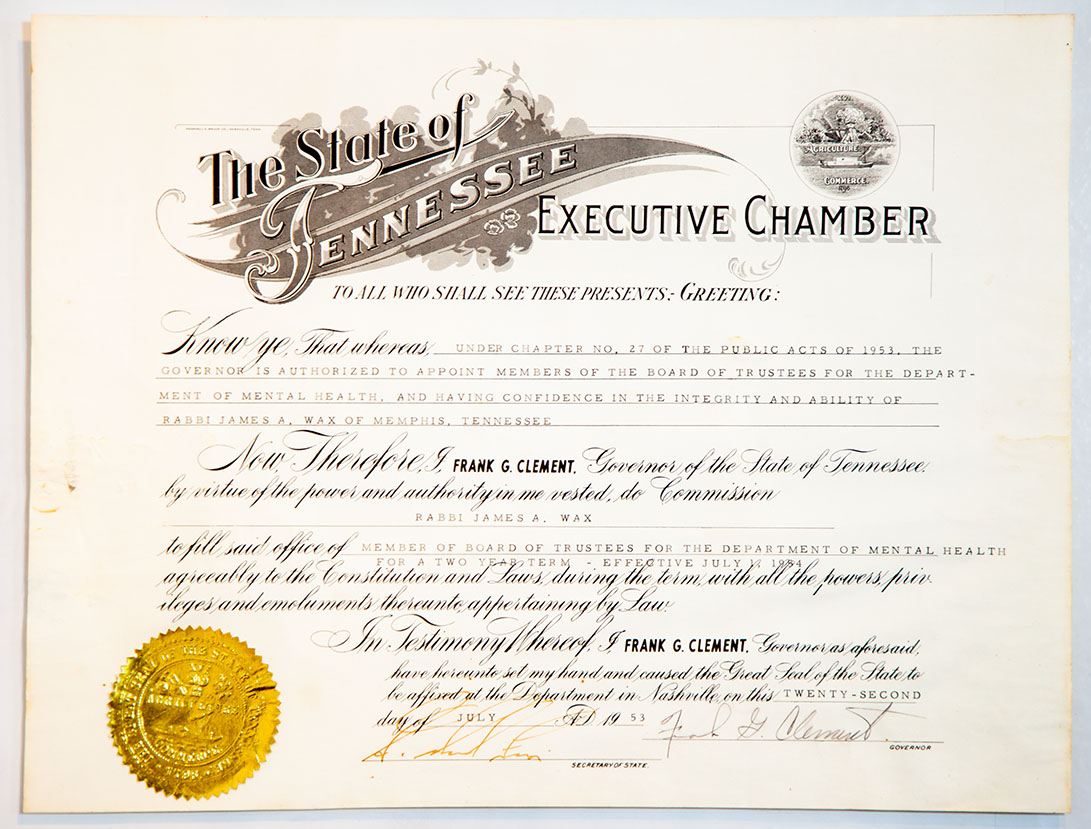
Rabbi Wax organized committees and invited speakers that attracted media attention for his push to build a mental health clinic in Memphis and for the state to establish a similar board. In 1953, Tennessee Governor Frank Clement appointed Rabbi Wax as a trustee on the first Tennessee Mental Health Board, a position he would hold for more than 25 years. In 1962, due to Rabbi Wax’s leadership on the issue, the Tennessee Psychiatric Hospital and Institute was opened near downtown Memphis. He often spoke to rabbinical conferences about the importance of mental health and how to address the needs of their congregations.
Rabbi Wax’s commitment to mental health sometimes captured headlines across Tennessee. He believed that state-run mental health hospitals should not be subjected to political influence, which brought him into direct conflict with Tennessee Governor Ray Blanton. In 1975, Rabbi Wax vehemently opposed Gov. Blanton’s patronage efforts at Western State Hospital in Bolivar, Tennessee, to fire the hospital’s professional superintendent and replace him with one of the governor’s political cronies. The state Mental Health Board later adopted a policy statement submitted by Rabbi Wax prohibiting hospital employees from dismissal except by the hospital’s superintendent.
In 1981, the Mental Health Commission named the James A. Wax Activities Building at the Memphis Mental Health Institute in honor of its senior member. Rabbi Wax retired from the board in 1984 after 28 years of service and appointments by five governors.
1974
Tennessee Mental Health Magazine
March, 1974
Rabbi Wax clashes with Governor Blanton over politicization of Mental Health Department
September 30, 1975
1975
1975
“Blanton, Board Clash Over Ninow,” September 30, 1975 Memphis Press-Scimitar.

October 1, 1975
In another showdown between Rabbi Wax and Gov. Blanton over the Mental Health Department, Rabbi Wax states: “The sad fact, governor, is the people of our state disapprove, strongly disapprove of any political intervention in the operations of our hospitals.”
1975

Lasting Impact
Lasting Impact
The inauguration of the new Temple Israel in 1976 marked a significant milestone in the congregation’s history and its commitment to Jewish heritage.
Rabbi Wax’s proudest moment came September 17, 1976, when the first Shabbat service was held in the new Temple Israel at 1376 East Massey Road.
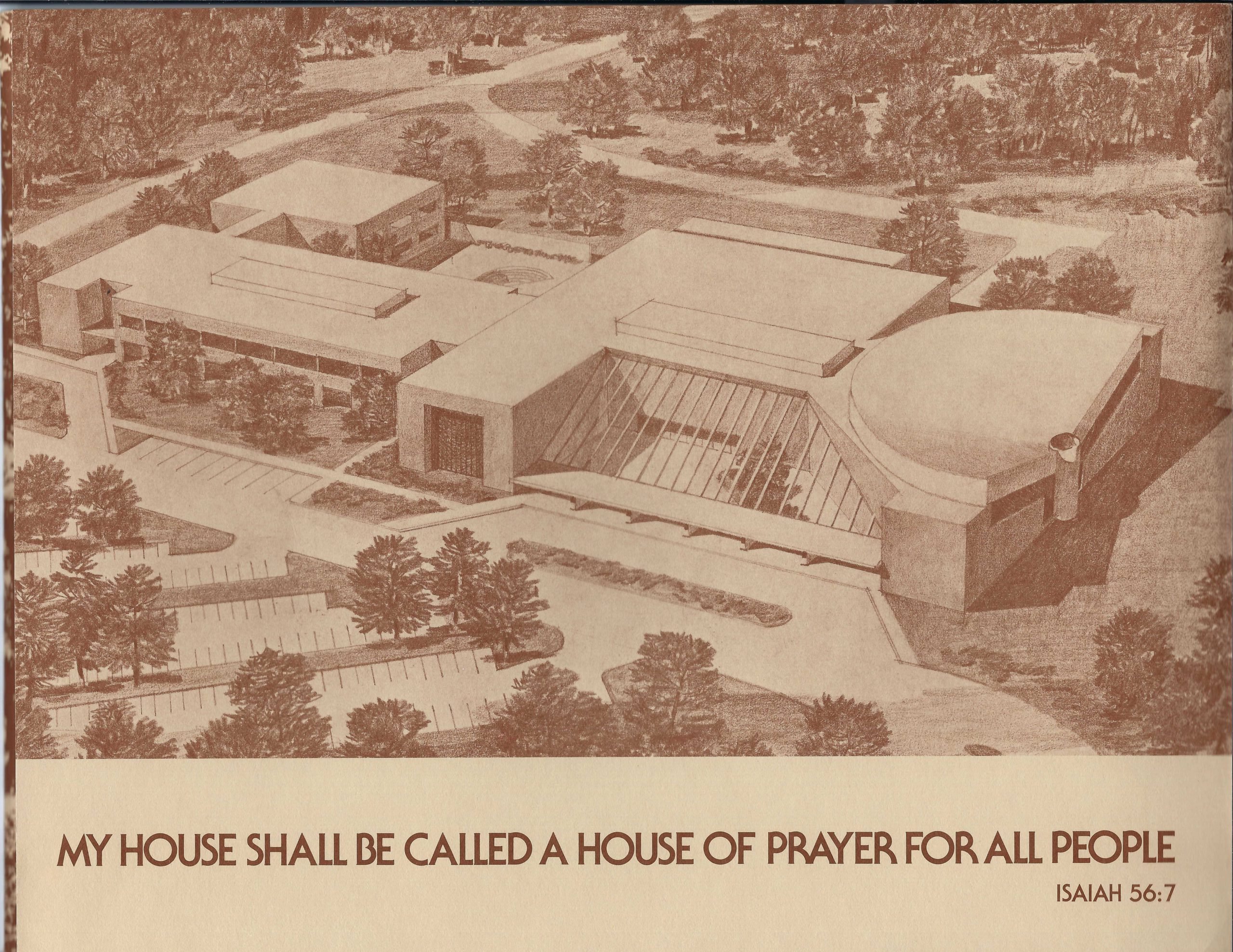
Discussions about leaving the old synagogue at Poplar and Montgomery, which housed Temple Israel for 60 years, had been ongoing for nearly a decade when, in 1963, advocates created plans for a new building. In 1964, 14 acres on the northwest corner of White Station Road and Sanderlin were purchased for $100,000 – 10 miles east of the old Temple. By 1970, the congregation had outgrown the building at Poplar and Montgomery and Rabbi Wax knew it could no longer respond to the needs of many of Temple Israel’s members who were moving their families to the eastern parts of the city.
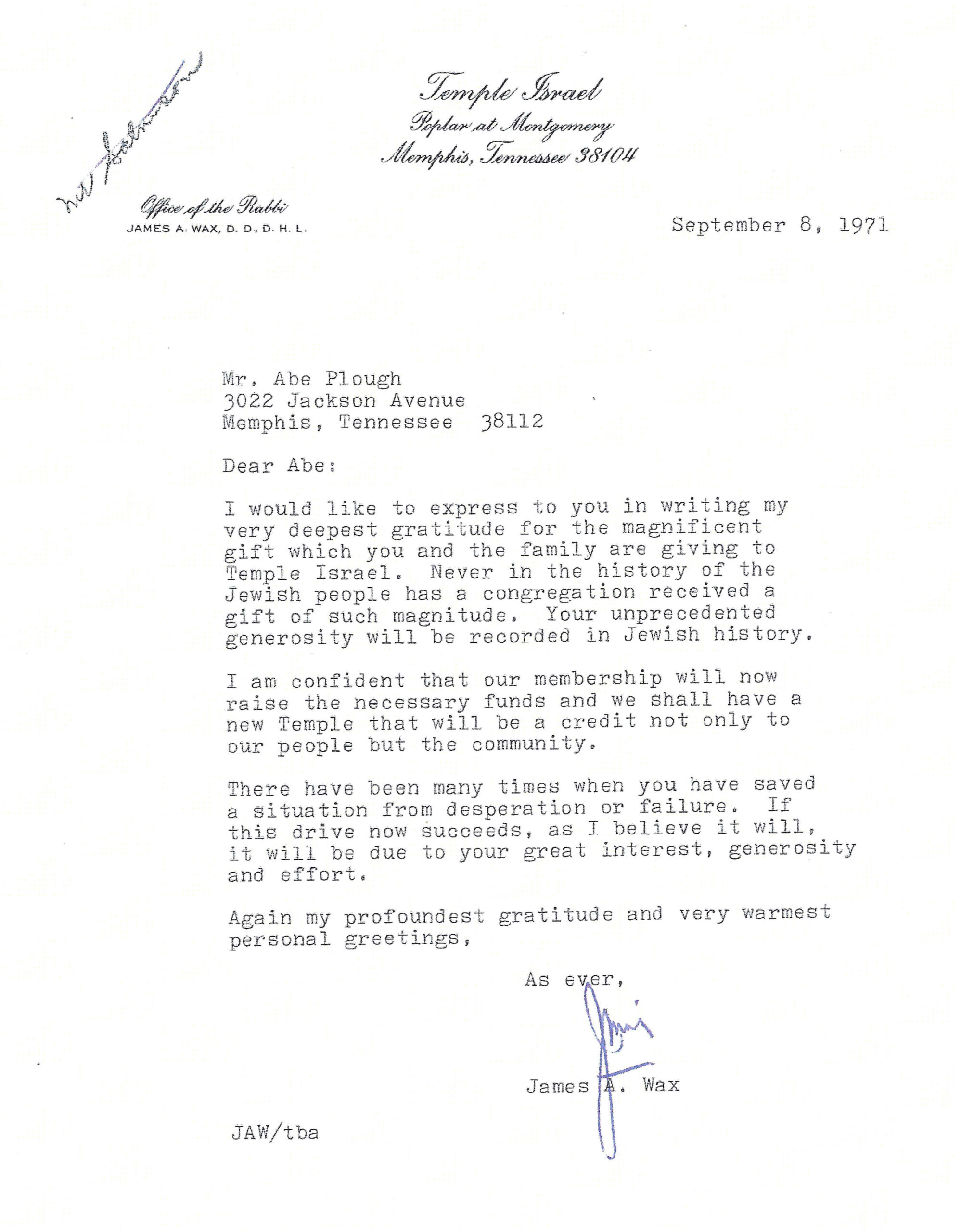
In 1972, with the support of the Temple’s leadership, including Sam Cooper and S.L. Kopald, Jr., Abe Plough pledged $1 million to build a new synagogue on a 30-acre wooded property for sale at 1376 East Massey Road, provided that the congregation would raise another $2.5 million. Rabbi Wax wrote to Mr. Plough: “Never in the history of the Jewish people has a congregation received a gift of such magnitude.”
The White Station property was sold for nearly $1 million, and the money was used to buy the Massey Road site. The old synagogue at Poplar and Montgomery was sold to Mid-America Baptist Theological Seminary, aided by a generous donation from Mr. Plough. Overcome with emotion and pride, Rabbi Wax delivered a sermon about the importance of the new Temple on the eve of Rosh Hashanah, September 24, 1976, a week after the dedication of the new building:
“The completion of this magnificent structure is an extraordinary achievement of which we can all be proud. By building this Temple we have demonstrated our will, our determination, to keep alive the religious heritage of our people…”

Rabbi Wax and Abe Plough at Temple Israel Groundbreaking, East Memphis.
1976
First Shabbat eve service takes place in the new Temple Israel
September 17, 1976
“We of this generation witnessed the greatest threat to Jewish survival in our long history…Like all of you, I had read about heard about Auschwitz, but it was not until I walked into that place that I learned the meaning of Jewish history. I emerged from that horrible place a different person, with an understanding of what it means to die for the sanctification of God’s name… I returned to Memphis with a passionate determination that we should do everything we could to perpetuate and strengthen Jewish Life. Yes, I pleaded, I implored, that we build a new Temple… I look upon this new Temple as a means by which to sustain our people and perpetuate our heritage. (The synagogue) unites us with our fathers in a bond that endures and expresses the meaning and purpose of Jewish survival.”

Rabbi Wax delivers a sermon about the importance of the new Temple
September 24, 1976
Overcome with emotion and pride, Rabbi Wax delivers a sermon about the importance of the new Temple on the eve of Rosh Hashanah, a week after the dedication of the new building:
…Indeed, the dedication of this Temple transcends time and place. Even as the synagogue was the prime institution in Jewish life in the past, it is no exaggeration to assert that it must be the central institution of Jewish Life in America if the Jew and Judaism (are) to survive.
1976
1976
Temple Israel’s main sanctuary
The 1,500-seat sanctuary at Temple Israel, designed in a semicircular fashion, symbolizes an inclusive space, with one half dedicated to the congregation within and the other half to the broader community. In September 2021, the sanctuary was officially named the Greenstein Sanctuary in tribute to Rabbi Micah D. Greenstein’s 30-year tenure at Temple Israel.
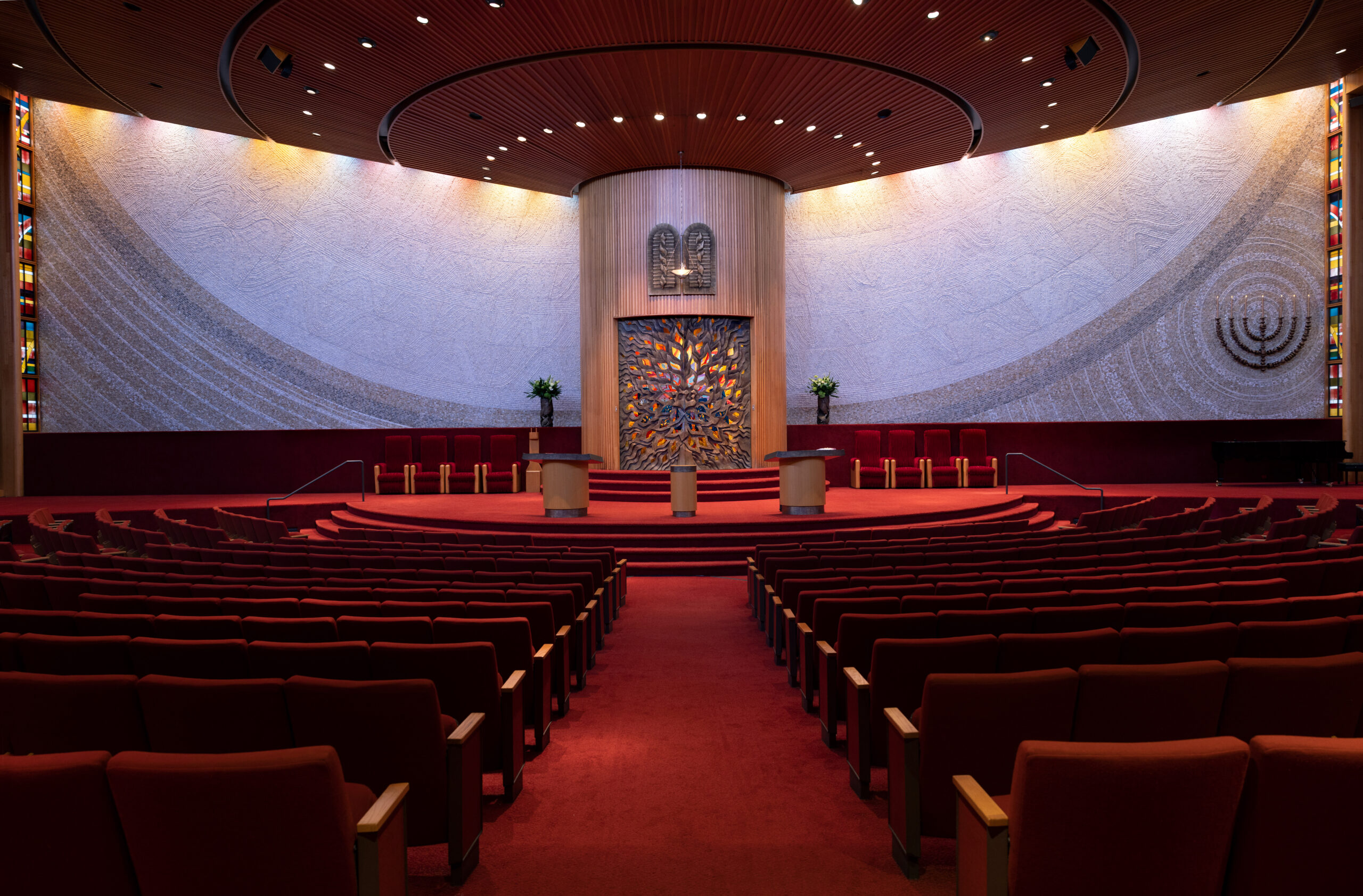
Photo courtesy Lisa Waddell Buser
Lasting Impact
The new Temple Israel would prove to be a significant milestone in Wax’s life and legacy.
A Legacy of Leadership, Courage & Meaning
The dedication of the new Temple Israel was the climax of an improbable story about a Jewish boy who rose to become one of the nation’s leading Reform rabbis and who helped to shape the history of Memphis. He preached the meaning of Judaism and he faithfully lived it, inspiring others to share his courage and to stand for what was right by the laws of man and God.
On March 11, 1978, Rabbi Wax gave his final sermon as senior rabbi of Temple Israel. Throughout retirement, Rabbi Wax continued to write columns about social justice for local media, taught at the Memphis Theological Seminary, and continued his service as a rabbi to small Mid-South Jewish communities. Another priority was to build bridges between religious groups. His memberships and honors are numerous, including the National Conference of Christians and Jews and the Memphis Ministers Association. He gave more than 750 sermons, wrote thousands of letters, and gave numerous interviews on Judaism.
Rabbi Wax died on October 17, 1989, after suffering an aneurysm while conducting Yom Kippur services at Temple Beth El in Helena, Arkansas. His last words were about the moral right of every person to have decent, affordable health care. His death and interment at Temple Israel Cemetery spawned tributes from across the country by people of all faiths.
Said Rabbi Wax’s friend, Rev. Frank McRae: “Jews are better Jews and Christians are better Christians because Jimmy was around.”
Rabbi Wax’s longtime friend, Rabbi Hertz delivered the eulogy. He said inpart: “Rabbi Wax was truly a rabbi’s rabbi. For him God was very real. His broad humanitarianism enabled him to exemplify in his ministry the highest ethical traditions of prophetic Judaism…Some men build in steel, some in stone, some in glass, some in concrete. Rabbi Wax built in human hearts. He gave unsparingly of his time, energy, and heart to the troubled, the sick and the sorrowing…He leaves behind to loved ones and to his community the sweet memories of a meaningful life dedicated to the service of his fellowman. What he did and what he gave of himself shall endure as long as this Congregation remembers.”
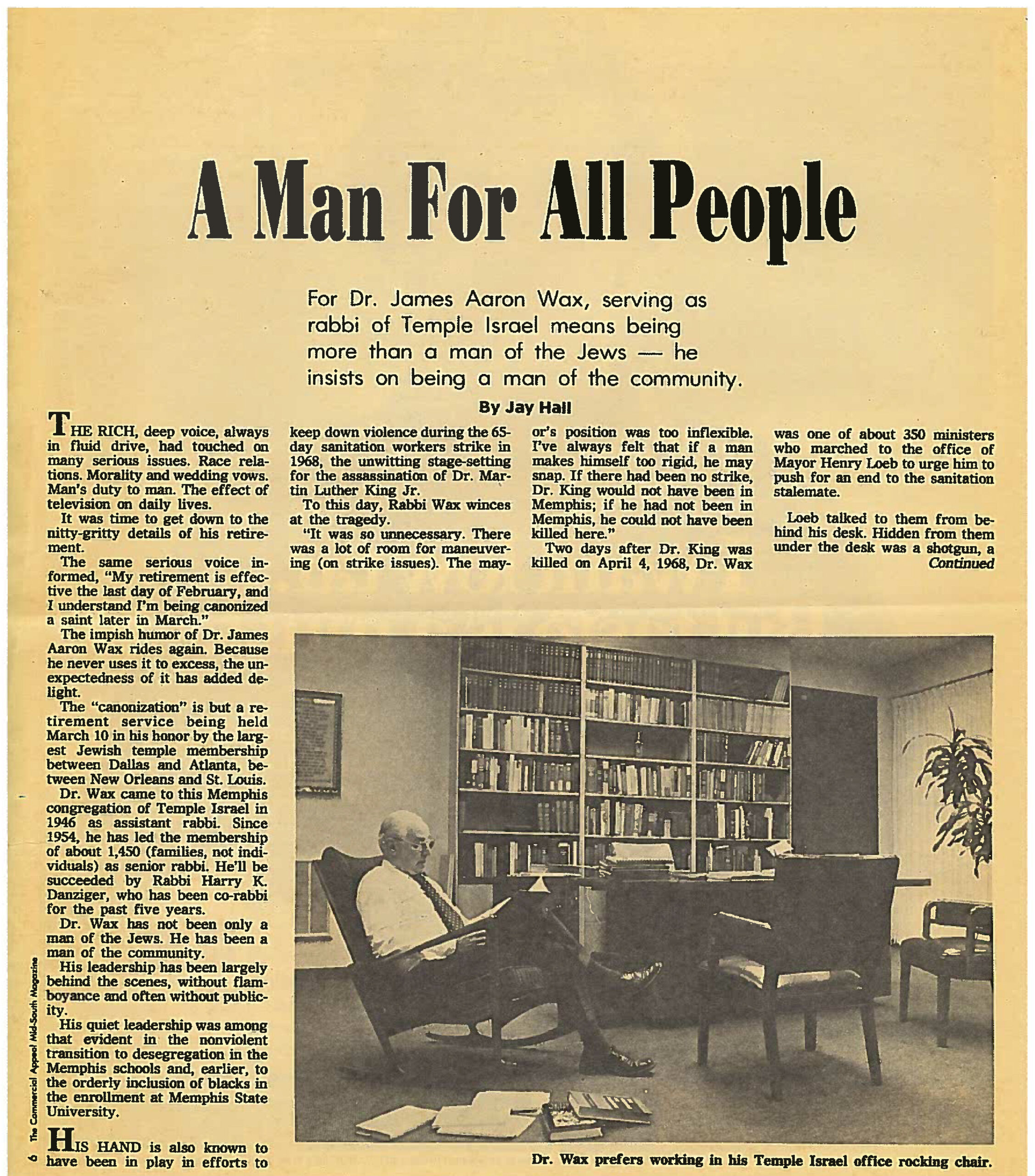

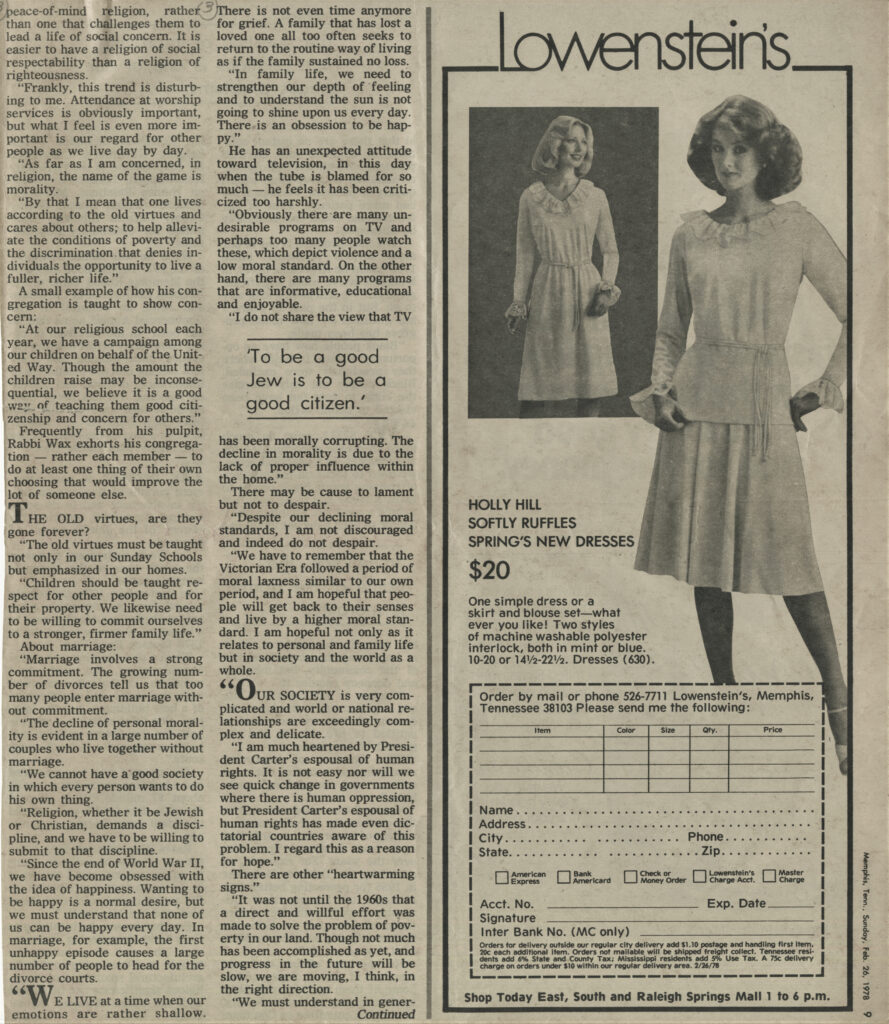
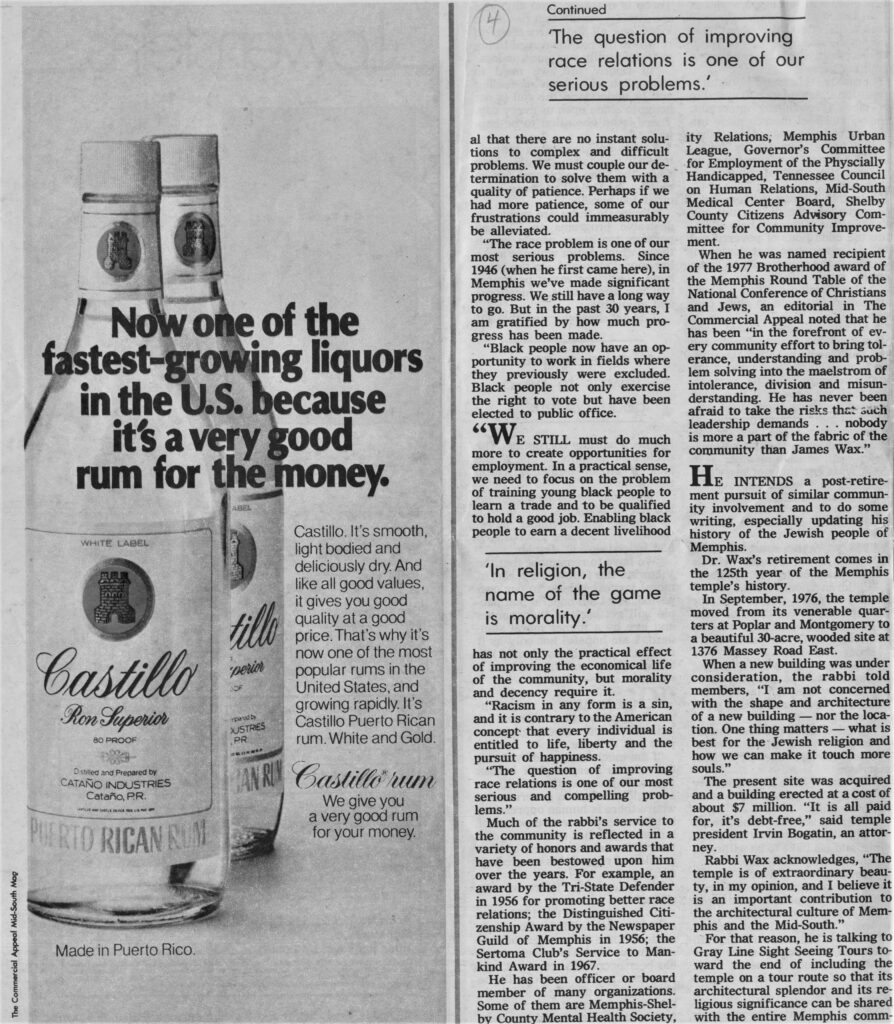









1977
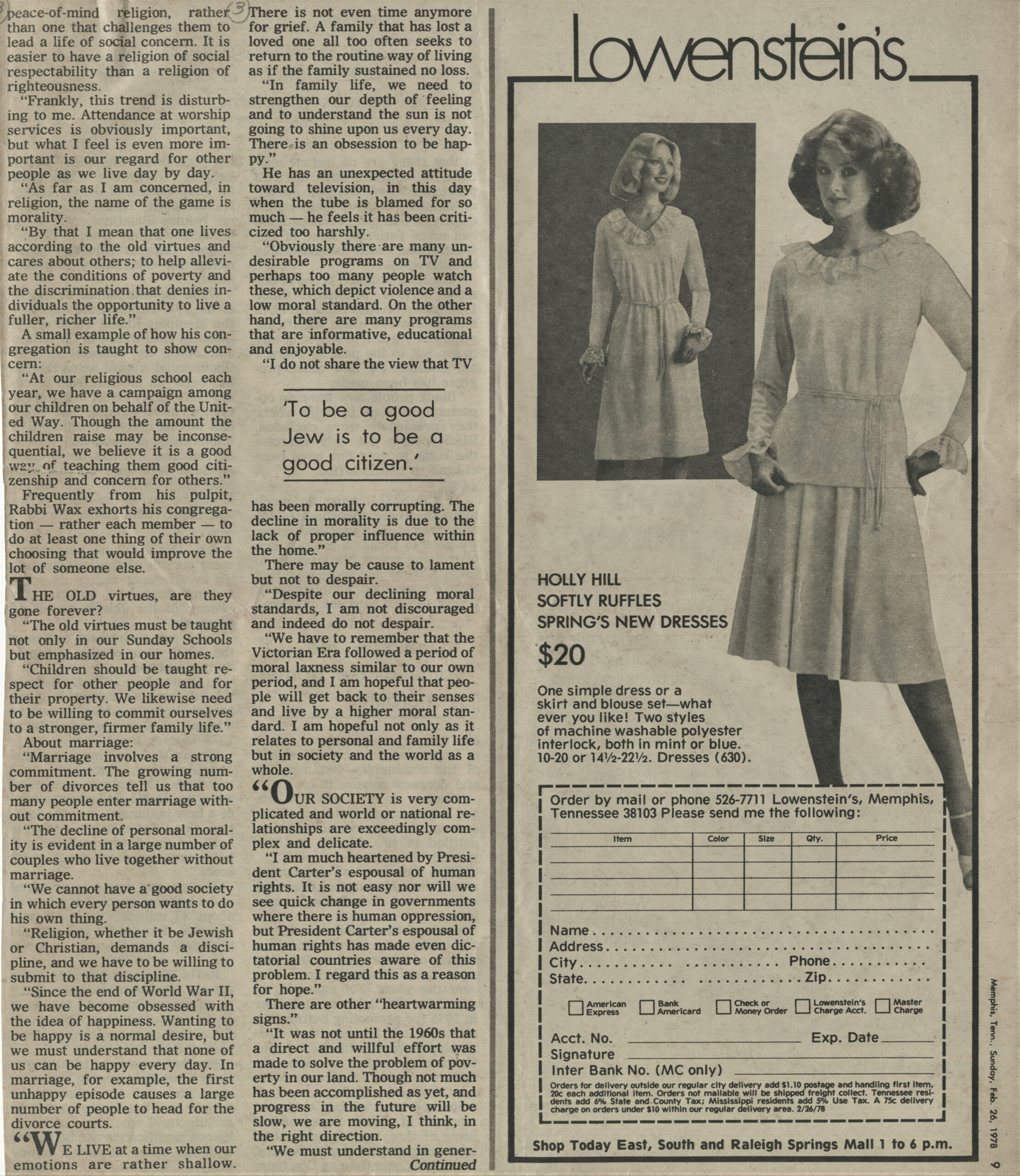
Recipient of Brotherhood Award from National Conference of Christians and Jews
Rabbi Wax is presented the 1978 Human Relations Award from National Conference of Christians and Jews
February 28, 1978
Rabbi Wax received an honorary doctorate of Hebrew letters from Hebrew Union College, honorary Doctor of Humanities degrees from Christian Brothers University and Rhodes College, and an honorary Doctor of Divinity degree from Tusculum College, a Presbyterian college that was the first college in Tennessee to admit African Americans.
1978
1978
Rabbi Wax receives Multiple Distinguished Awards
Rabbi Wax received the Citizenship Award from the Newspaper Guild of America, the ACLU’s Bill of Rights Award, the Memphis Urban League’s Outstanding Service Award, the National Conference of Christians and Jews National Human Relations Awards, and more.
Rabbi Wax was a popular instructor at the Memphis Theological Seminary where he taught a course in Hebrew studies for 13 years. He hosted a weekly radio program, Message of Judaism, and served as a regular panelist on the weekly local television show, What Is Your Faith?

Rabbi Wax’s final sermon before becoming rabbi emeritus
March 11, 1978
1978
1981
The Mental Health Department names the James A. Wax Activities Building at the Tennessee Mental Health Institute in honor of its senior member
Rabbi Wax retires from the Tennessee Department of Mental Health board of trustees
1984
1987
James A. Wax Collection given to the Memphis and Shelby County Room, Memphis Public Libraries
A Legacy of Civic Leadership
Rabbi Wax was among the early supporters of efforts to build St. Jude Children’s Research Hospital in Memphis. He also served on the board of the United Cerebral Palsy Association, the Shelby County Tuberculosis Association, and the Mid-South Center Council for Comprehensive Health Planning
Another priority was to build bridges between religious groups, and he supported his friend and colleague, Rabbi Arie Becker, in his efforts to raise money to build a new synagogue for the city’s Conservative Jewish congregation, Beth Sholom. Rabbi Wax saw Rabbi Becker, a survivor of Auschwitz, as a kindred spirit for social justice after Becker joined 19 other Conservative rabbis in 1963 in Birmingham, Alabama, to march for racial equality only a few months before the 16th Street Baptist Church was bombed by white supremacists killing four young girls and injuring 22 others.
Rabbi Wax was devoted to Jewish education and religious organizations, serving on the board of governors of the HUC and the Central Conference of American Rabbis. He was president of Southwest Conference of American Rabbis and served on the executive council of the American Jewish Historical Society and the American Jewish Committee.
During his rabbinate, he gave more than 750 sermons, wrote thousands of letters, and gave numerous interviews on Judaism. His position on controversial issues was well known. He opposed capital punishment, he supported the United Nations, and he opposed Tennessee’s anti-evolution law. He said: “There is not a single scientific fact, including evolution, that has undermined a single religious truth. God remains the Creator whether the world was formed in six days or six million years.”
Rabbi Wax suffers an aneurysm while conducting Yom Kippur services at Temple Beth El in Helena, Arkansas, where he had been acting rabbi since 1978. His last words were about the moral right for every person to have decent, affordable health care.
October 8, 1989
1989
1989
Rabbi Wax dies at age of 76
October 17, 1989
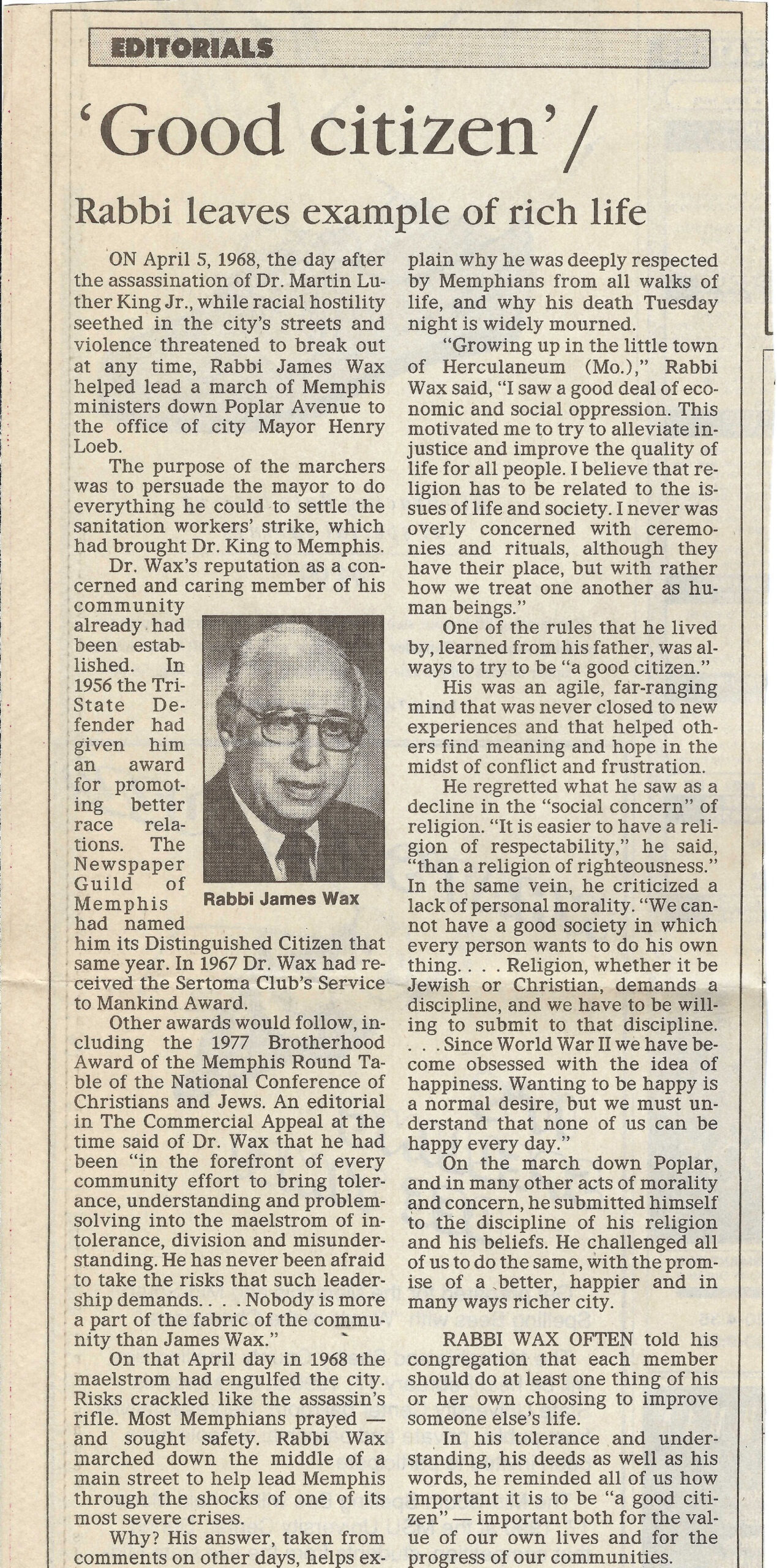
Editorial tribute to Rabbi Wax published in The Commercial Appeal following his death on October 17, 1989
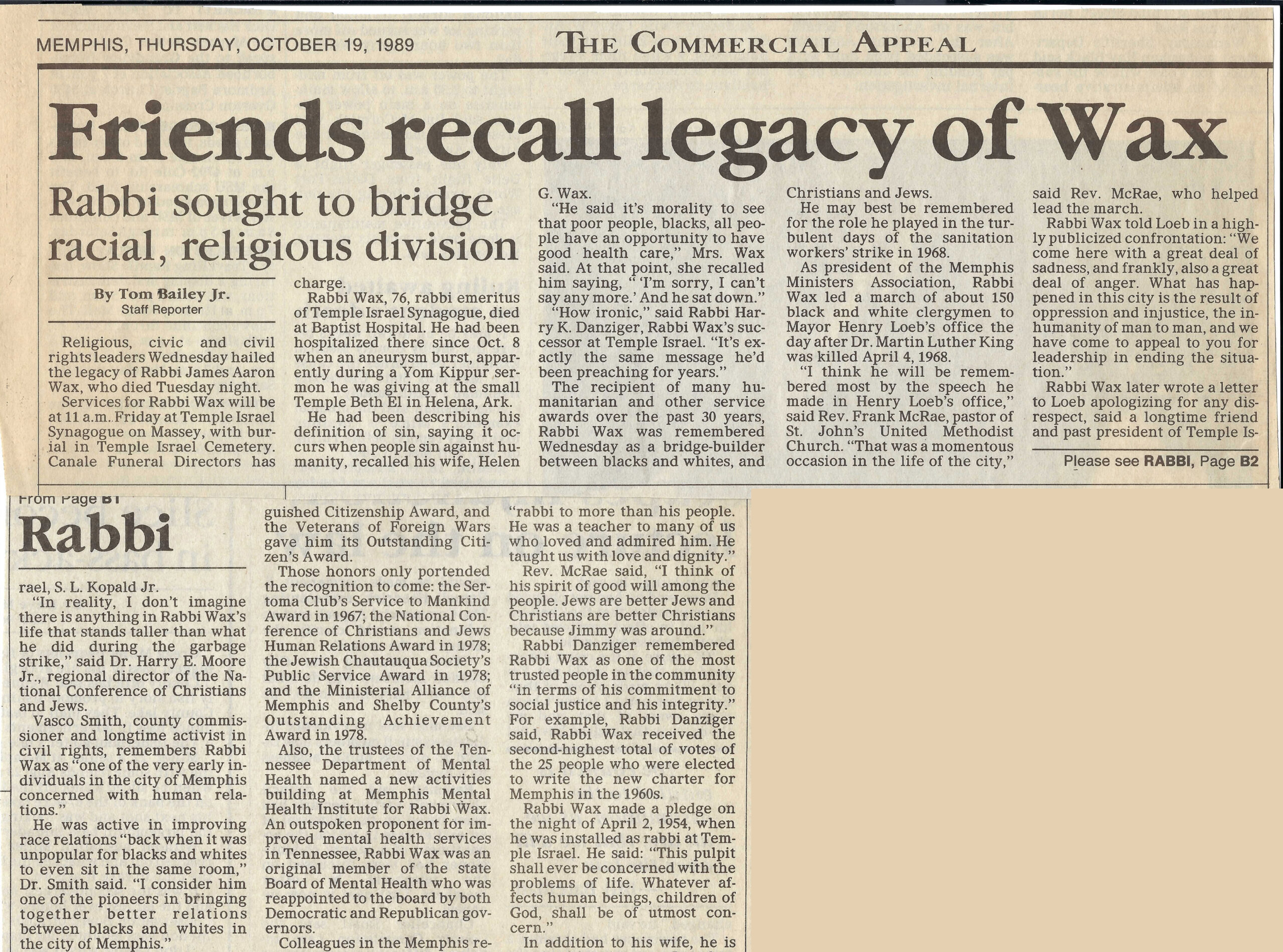
Friends recall legacy of Wax
October 19. 1989
1989
1990
Temple Israel names social hall the Ettelson-Wax Social Hall
November 2, 1990
Rabbi Wax is featured in the Upstanders in Memphis History Mural commissioned by Facing History & Ourselves to share stories of extraordinary Memphians who embraced the challenge to speak out, stand up for others, and make decisions that have helped to create a more inclusive, just, and compassionate Memphis.
2016
2016
Rabbi James A. Wax in the Facing History & Ourselves Upstander Mural


Rabbi James A. Wax in the Facing History & Ourselves Upstander Mural (detail)
2016
“The most difficult part was to stand on the pulpit and say what you did not want to hear, the inner suffering of saying what was not popular. But the responsibility of the rabbi is to speak the word of God as he understood it. I never enjoyed controversy. It was very difficult for me. But if a rabbi is true to his word, he must be involved in fighting racial prejudice and injustice and social oppression. If I was true to my calling, I felt I must speak out against racism, oppression, and injustice. Why I spoke what I did, why I did what I did, was mandated by God.”
— Rabbi James A. Wax
Lasting Impact
Temple Israel continues to be a staple of the Jewish faith in the Mid-South.
Temple Israel’s Rabbinical Tradition of Community Service
Since Temple Israel was founded 168 years ago, eight senior rabbis have led the congregation, each of whom embraced community service as an important part of his mission. Years before social action became the clarion call of Reform Judaism, these spiritual leaders took the teachings of the Torah beyond the synagogue to improve the health and welfare of the community at large.
Rabbi Jacob Peres, 1858-1860
The first rabbi to lead Temple Israel, then known as The Congregation of the Children of Israel, was Jacob Peres who laid the foundation of community service. Although his tenure as senior rabbi was only two years, he remained active in the Memphis community serving as president of the Memphis School Board during a time in which the city built three modern schools, established a physical education program, and strengthened the curriculum.
Rabbi Simon Tuska, 1860-1870
Simon Tusca served as Temple Israel’s senior rabbi during the Civil War and Reconstruction. He led the transition of the congregation’s worship services from Orthodox Judaism to Reform Judaism as he worked to strengthen the synagogue’s ties with the greater community. After the Civil War, Rabbi Tusca led his congregation’s highly recognized communitywide involvement in education, medical care, and philanthropy.
Rabbi Max Samfield, 1871-1915
For Max Samfield, public service was a passion. As rabbi of the congregation during the yellow fever epidemics of the 18970s, a time in which many people fled to other cities, Rabbi Samfield remained in Memphis and ministered to the sick and dying. A resolution in his honor said in part: “He ministered to the sick; brought consolation to the stricken; gave sympathy to the orphan; and by torchlight buried his dead. He made no distinction either in race or condition, but the Gentile as well as the Jew were the beneficiaries of his volunteer services.” He was held in such high esteem throughout Memphis that when he died in 1915, every streetcar of the Memphis Street Railway Company halted for a full minute in his honor.
Rabbi William Fineshriber, 1915-1924
William Fineshriber served as Temple Israel’s senior rabbi for nine years, but his influence is still felt today. An early advocate of women’s suffrage, Rabbi Fineshriber is mostly remembered for having the courage to speak out against racism and bigotry in Memphis during a time it was dangerous to do so, particularly his outspoken stance against lynching and criticism of the Ku Klux Klan as a menace to America. He was a champion of literary scholarship and freedom of thought and whose courageous advocacy of social justice would inspire this congregation for more than a century.
Rabbi Harry W. Ettelson, 1925-1954
Harry Ettlelson already was a seasoned rabbi when he became senior rabbi at Temple Israel, having also served as a Navy Chaplain during World War I. His 29-year tenure at Temple Israel embraced the precepts of what was known as Classical Reform Judaism, which proclaimed it a sacred duty of Jews “to solve the problems presented by the contrasts and evils of the present organization of society.” During his leadership, Rabbi Ettelson organized the Cross-Cut Club, a group of local clergymen who sponsored non-sectarian programs. The club later formed the nucleus of the Memphis chapter of the National Conference of Christians and Jews.
Rabbi James A. Wax, 1954-1978
Rabbi Harry K. Danziger, 1978-2000
Having endeared himself to the congregation when he served as assistant rabbi for five years under Rabbi James Wax, Harry Danziger was the overwhelming choice to succeed Rabbi Wax as senior rabbi in 1978. Rabbi Danziger worked to familiarize the greater community with Judaism as he quietly transitioned his congregation’s Judaic worship away from classical reform to traditional reform. During his rabbinical leadership, he encouraged Temple Israel’s congregants to participate in communitywide tzedakah (charitable) efforts, which culminated in Mitzvah Day when hundreds of Temple Israel members participated in service projects throughout the community. Rabbi Danziger also served as board chairman of the Metropolitan Inter-Faith Association (MIFA), and as president of the Central Conference of American Rabbis.
Rabbi Micah Greenstein, 2000-Present
Micah Greenstein was a newly ordained rabbi when he came to Memphis in 1991 as the assistant rabbi under Rabbi Danziger. He picked up the pace of programming at Temple, created purposeful activities for the congregation, and began his dedicated and career-long effort to connect Temple Israel with
lay and religious leaders throughout the city’s Christian, Muslim, and African-American communities. Rabbi Greenstein quickly became a familiar sight at civic and religious events in Memphis and the nation, including his service as a member of the Executive Board of the National Civil Rights Museum, a member of the Board of Directors of the NAACP, an adviser to the city’s Race Relations and Diversity Institute, president of the Memphis Ministers Association, and as a popular speaker at Calvary Episcopal Church’s Lenten Series.
Sponsors & Supporters
Righteous Among Men: Rabbi James A. Wax
A Life Dedicated to Social Justice
Presented by the Temple Israel Museum
Home of the Herta and Dr. Justin H. Adler Collection of Judaica
Created by Susan Adler Thorp and Tom Jones
Curated by Laura Gray McCann
Graphic Design and Printing by Spark Printing
Audio/Visual Content & Design by Running Pony
Presenting Sponsors
Herbert Shainberg Foundation
James A. Wax Family
Jonathan I. Wax
James A. Wax, Jr.
James R. Wax
Upstanders
Carol & Bert Barnett
Elvis & Robert T. Goldsmith Fund
Ann & Mason Hawkins
Advocates
Family of Joy & Leo Bearman
Doris & Hubert Kiersky Charitable Remainder Trust
Robin & Billy Orgel
Leigh & Craig Royal
Diane Rudner
Susan Adler Thorp
Supporters
Rose Merry Brown
Congressman Steve Cohen
Sheril & Rabbi Micah Greenstein
Natalie & Jimmy Jalenak
Elaine & Robert Kaufman
Barbara B. Lapides
Myrna & Joe Levy
May Lynn Mansbach
Memphis Jewish Federation
Metropolitan Inter-Faith Association
Monogram Foods
NAACP
National Civil Rights Museum
Judy & Nick Ringel
Diane Sachs & Robert Vidulich
Hedda Adler Schwartz
Edward J. Wise
Special Thanks
American Jewish Archives, Hebrew Union College, Cincinnati, Ohio
Dixon Gallery and Gardens, Memphis
Memphis Public Libraries, Memphis Room, The Rabbi James A. Wax Collection
Herculaneum Historical Society
Reverend James M. Lawson
Rabbi Harry K. Danziger
Rabbi Wax Portrait Courtesy of Alan Karchmer
Temple Israel Archives, Memphis
The Family of Rabbi James A. Wax: Jonathan I. Wax, James A. Wax Jr., James R. Wax